
Mortgages
How are interest rates changing right now? July 2026
See how interest rates are shifting, the lowest rates available, and how much you could negotiate right now.
Property Investment
2 min read
For months, interest rates have sat pretty much still.
The longer-term rates nudged up a bit.
This time, it’s the shorter-term rates’ turn.
Here’s what’s going on.
The 1-year to 2-year rates are all up between 0.18% and 0.24% since last month.
The average negotiated 1-year rate is now 4.82%. Last month it was 4.63%.
Most banks advertise a 1-year rate of 4.99%. ANZ, BNZ, TSB, Kiwibank and Westpac are all sitting there.
ASB is the only one lower, at 4.95%.
But the average rate people actually get when they refix is 4.82%.
That's because we've seen a return of the secret bank discounts. So the average discount on the 1-year rate is about 0.16%.
There are bigger discounts on the 2-year rate. The average bank gets the scissors out and chops 0.23% off its 2-year rate.
The biggest jump is in the 18-month rate.
Last month, I told you the lowest 18-month rate in the market was 4.79%. It's now 5.09%. That's a jump of 0.30% in a month.
The lowest negotiated 1-year rate is 4.75%. That is up 0.16% on last month, when it was 4.59%.
One of the things you can look at to get a sense of where interest rates might go next is the swap rates.
Think of these as what it costs a bank to borrow money and lend it to you and me for our mortgages.
When swap rates go up, fixed mortgage rates usually follow.
Between the 8th and 15th of July, swap rates went from 3.10% to 3.35%. They've stayed around there for the last 2 to 3 weeks.
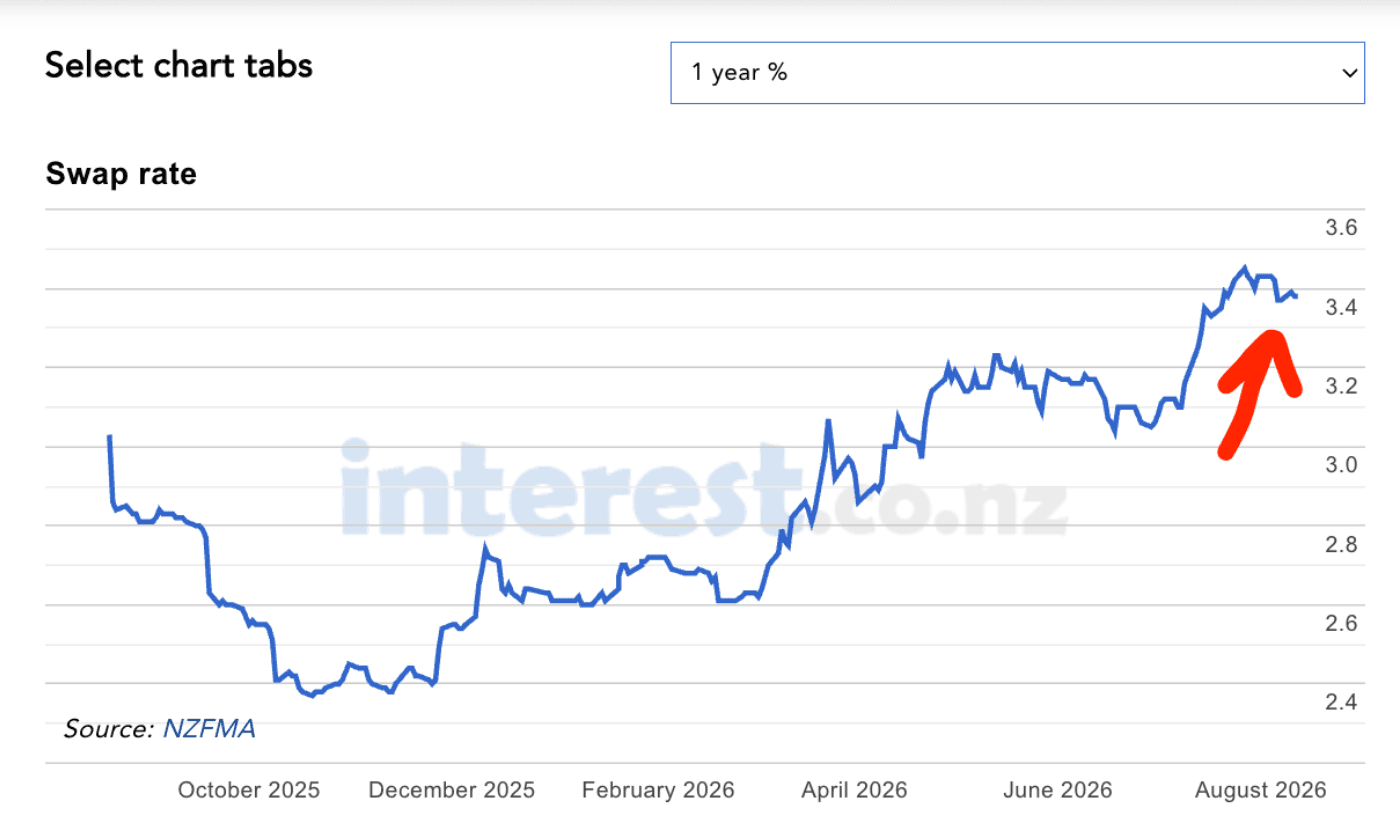
That was driven by the Official Cash Rate (OCR) announcement on the 8th of July 2026. The OCR is the Reserve Bank's interest rate. It went up 0.25%.
The market barely reacted on the day. But over the next few days, swap rates went up by roughly the same amount.
Inflation data came out on the 21st of July. It wasn't much of a surprise. Swap rates haven't really moved since.
So this was the OCR doing the work, not inflation.
The main thing I'm seeing right now is investors looking at the longer-term rates and thinking about locking in for longer.
Here's why.
Short rates have jumped. Longer rates have barely moved. The average negotiated 3-year rate is 5.33%, up just 0.03% this month. The 4-year and 5-year rates each moved 0.02%.
Last month, the gap between the average negotiated 1-year and 3-year rates was 0.67%. Now it's 0.51%.
So the extra cost of fixing for longer is smaller than it was a month ago.
That doesn't make it the right call for everyone. If rates fall from here, you'll be locked in at a higher rate. And breaking a fixed rate early usually means paying a break fee.
But if you are keen to have a chat about interest rate strategy, hit reply. Let me know your situation, and I'll come back to you.
Cheers,
Peter

Mortgage broker for over 10 years, property investor and Managing Director at Opes Mortgages
Peter Norris, a certified mortgage adviser with 10+ years of experience, serves as the Managing Director at Opes Mortgages. Having facilitated over $1.2 billion in lending for 2000+ clients, Peter is a respected authority in property financing. He's a frequent writer for Informed Investor Magazine and Property Investor Magazine, while also being recognized as BNZ Mortgage Adviser of the Year in 2018 and listed among NZ Adviser's top advisers in 2022, showcasing his expertise.
This article is for your general information. It’s not financial advice. See here for details about our Financial Advice Provider Disclosure. So Opes isn’t telling you what to do with your own money.
We’ve made every effort to make sure the information is accurate. But we occasionally get the odd fact wrong. Make sure you do your own research or talk to a financial adviser before making any investment decisions.
You might like to use us or another financial adviser