
Property Investment
What is your dream retirement?
Half of Kiwis don’t have a retirement plan. I think I know why. So, next week, I’m doing something about it. Here’s what we’re launching 👇
Property Investment
3 min read


Author: Andrew Nicol
Founder, 20+ Years' Experience Investing In Property, Author & Host
How do you tell if property prices are too high or too low?
An area like Queenstown is expensive. And a place like Gore might be cheap.
But a cheap area can be overpriced for what it is.
So how do you figure out if your area is overpriced?
Right now, Kawerau is among the cheapest places to buy a house in the country. The average house price is around $404k (QV, June 2026).
That’s way cheaper than the national average of $906k (QV, June 2026).
But here’s what most people miss. Kawerau is looking pretty expensive for what it is.
Over the last 34 years, Kawerau house prices have been about 0.33x New Zealand's average house price.
Let’s say the average NZ home was worth $1 million. You'd expect the average Kawerau property to be worth about $331k.
But, as I said, the average Kawerau property is currently worth about $404k.
It’s a cheap house. But Kawerau house prices are about 35% higher than you’d expect.
They’re overvalued by about $104k in my model.
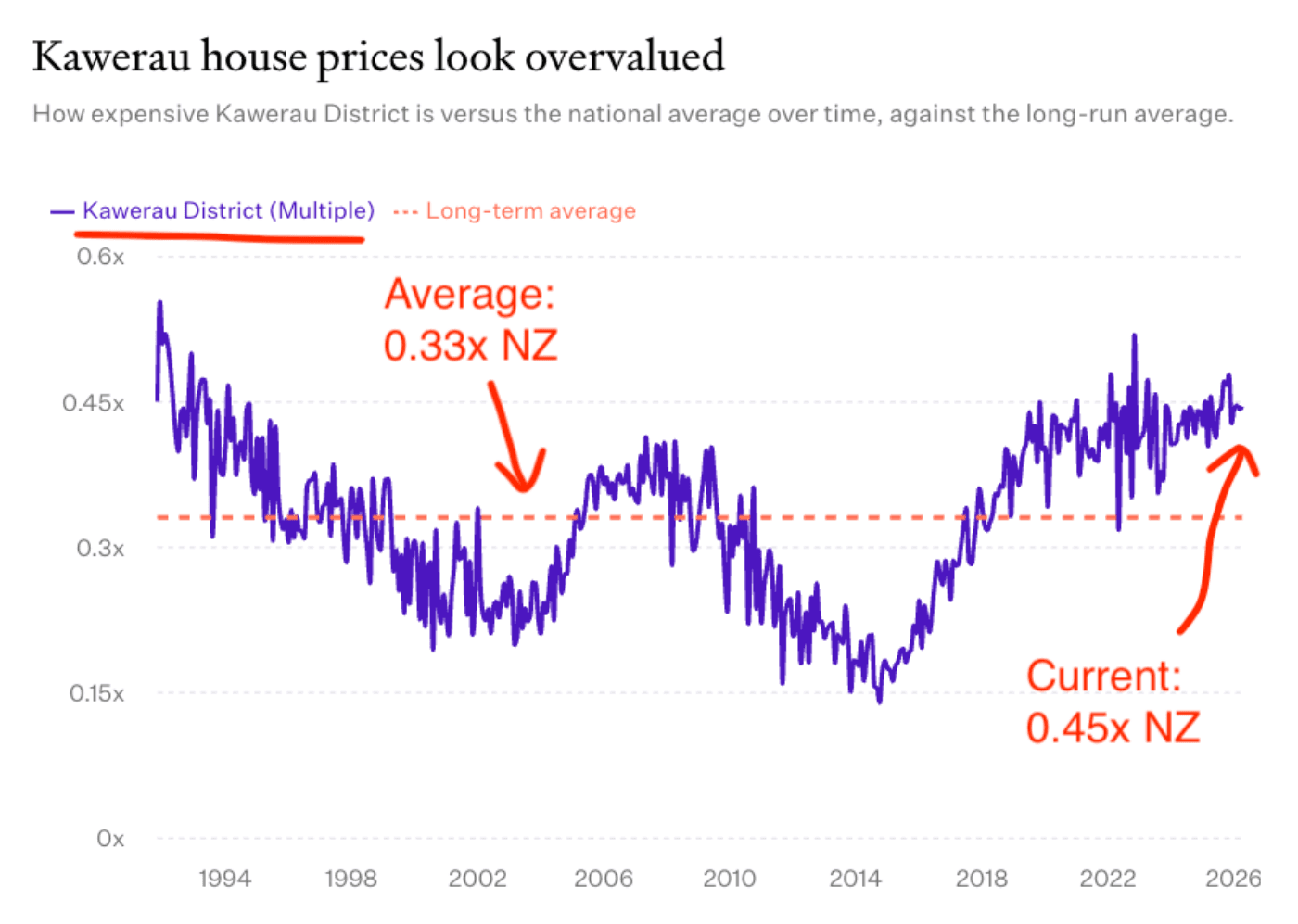
That doesn’t mean that Kawerau house prices are about to crash. And keep in mind that in small areas like Kawerau, there's going to be a wider margin of error because not many house sales take place.
But it does suggest that house prices might underperform the rest of New Zealand over the medium term.
And this is because things can be low-priced but still expensive. For instance, a $300,000 car is expensive. A $300,000 house is cheap.
How do you figure out whether a region is particularly cheap or expensive? That's what this model is for.
There is this concept in investing that things tend to move towards their long-term average.
If you want to be fancy, it's called mean-reversion. That’s just a nerdy way of saying that markets tend to get ‘back to normal’.
Because property prices in a region can get ahead of themselves during a boom. And get out of whack. The opposite can happen too in a downturn.
But, over time, they move back towards that long-term average.
For instance, in Christchurch, property prices really lagged from 2015-2020.
Property prices were going up in other parts of New Zealand, but Christchurch was lagging behind.
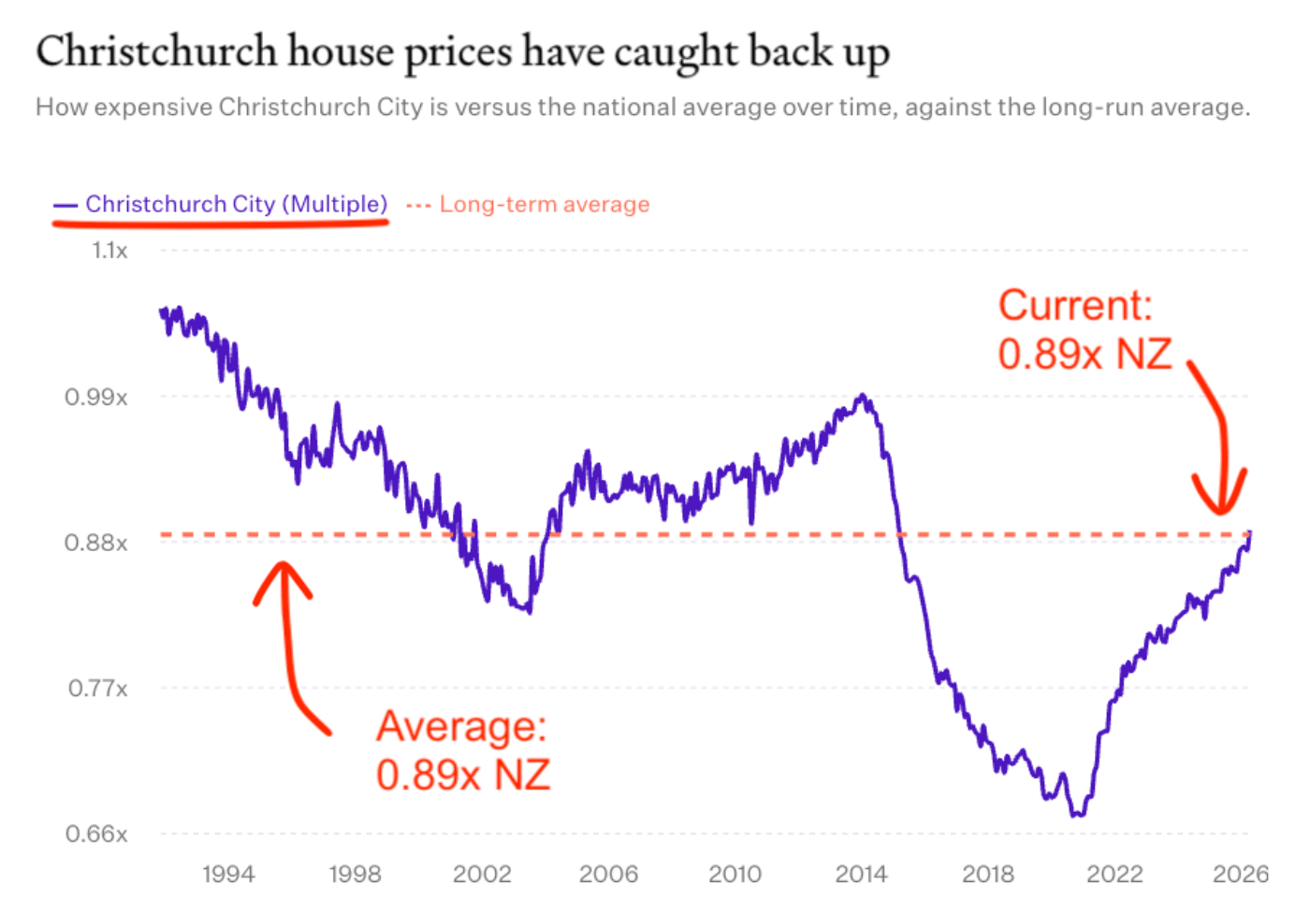
That ratio of Christchurch house prices versus New Zealand house prices got too cheap.
Then, during the most recent boom, Christchurch house prices have sped ahead of everywhere else, and it's now back at that long-term ratio.
So if you invested in Christchurch over that period, you could have made a lot of money. That’s if you bought it when it looked undervalued.
It’s not going to shock anyone that Auckland properties have been more expensive than the rest of the country.
Over the last 34 years, Auckland house prices have averaged around 1.4x the national average.
Right now, they are 1.31x that national average. So they look undervalued by about $78k in my model.
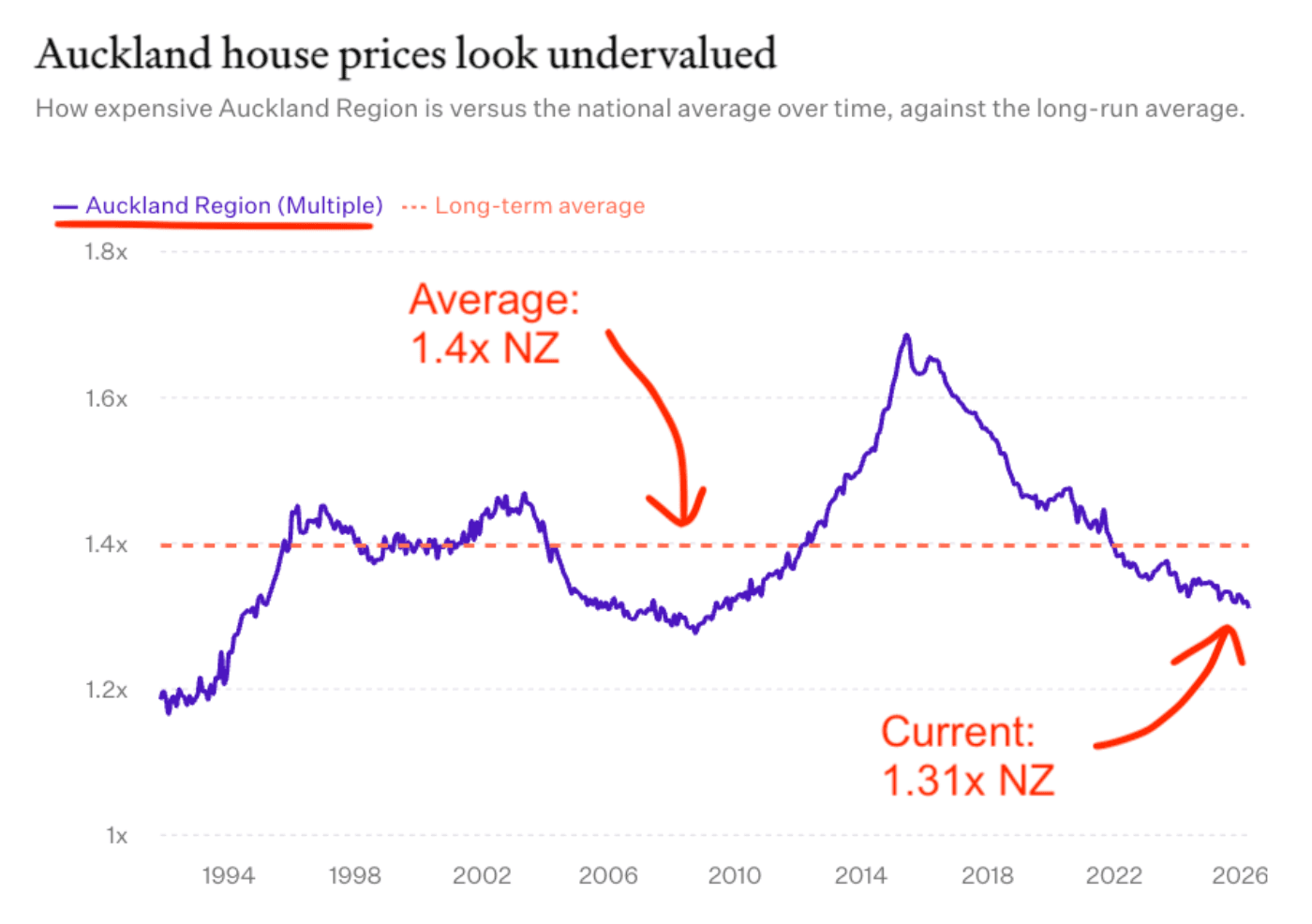
That doesn’t mean Auckland is cheap. It isn’t.
It's because Auckland is cheaper than it usually is compared to the rest of New Zealand.
This model is built on one assumption: That markets boom, cool off, and eventually go back to the baseline.
But you might also think ‘what if things change?’
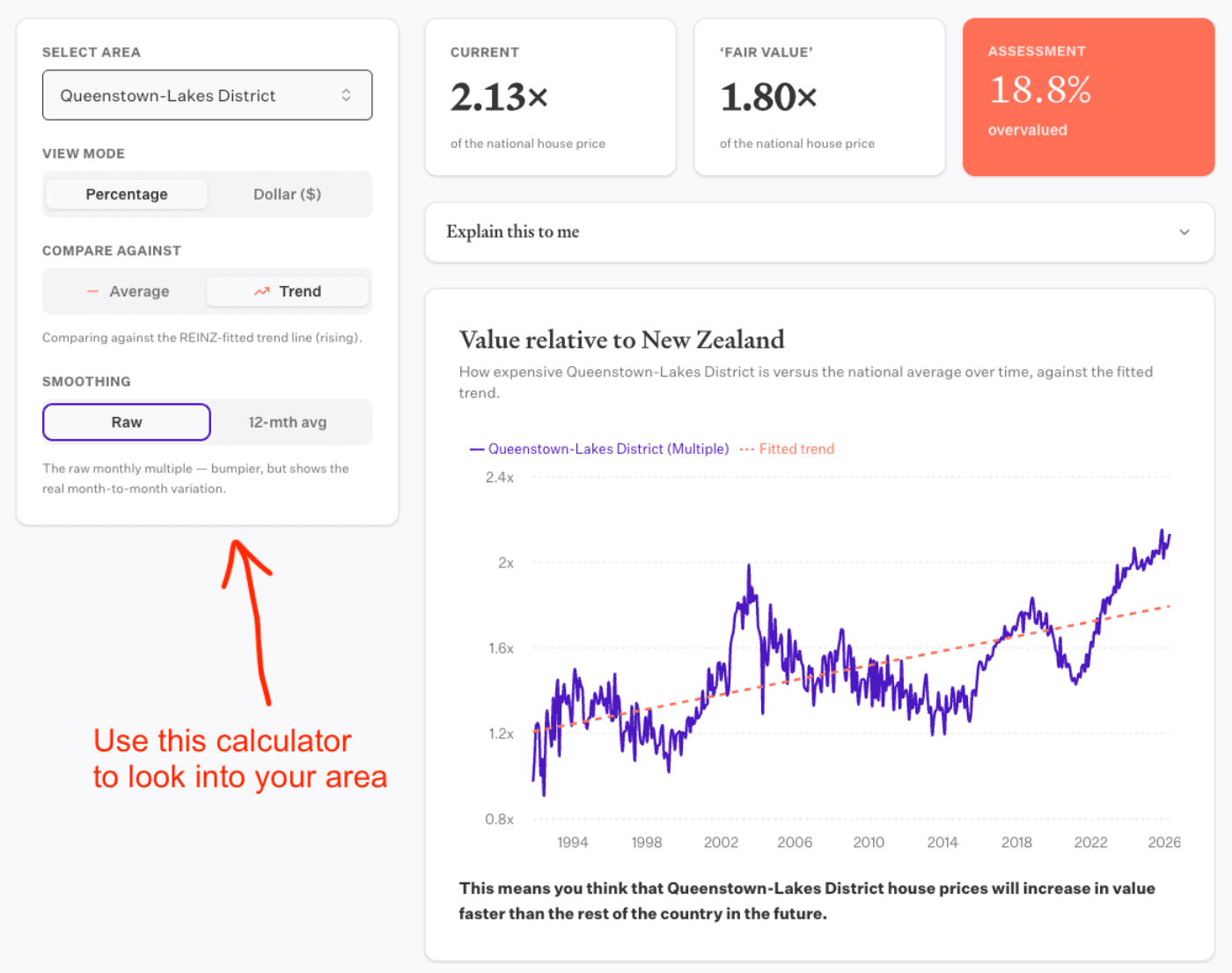
Take Queenstown. Over the same period, Queenstown has averaged 1.5x the average national house price. But it’s currently sitting at 2.13x.
Does that mean that Queenstown is in for a major shock? Or, is it that Queenstown has become more and more popular, so it's going to keep getting more expensive over time?
No model can tell you that for certain. Which is why I built you this calculator.
You choose your region, see how overpriced or underpriced it might be. Then you can see what would happen if house prices don't revert to their long-term average.
Of course not.
But it might help you avoid areas that look overpriced. Or, you might use it to spot value that everyone else has overlooked.
It's another tool in your investment toolkit.
Founder, 20+ Years' Experience Investing In Property, Author & Host
Andrew Nicol, Managing Director at Opes Partners, is a seasoned financial adviser and property investment expert with 20+ years of experience. With 40 investment properties, he hosts the Property Academy Podcast, co-authored 'Wealth Plan' with Ed Mcknight, and has helped 1,894 Kiwis achieve financial security through property investment.
This article is for your general information. It’s not financial advice. See here for details about our Financial Advice Provider Disclosure. So Opes isn’t telling you what to do with your own money.
We’ve made every effort to make sure the information is accurate. But we occasionally get the odd fact wrong. Make sure you do your own research or talk to a financial adviser before making any investment decisions.
You might like to use us or another financial adviser


