
Property Investment
Property Investment
3 min read


Author: Andrew Nicol
Founder, 20+ Years' Experience Investing In Property, Author & Host
The news keeps telling me there are too many townhouses in Auckland.
And it’s easy to believe when you see townhouses selling for $50k, $100k, or even $200k less than they did during the boom.
So, is there an oversupply of townhouses? And have we built too many in Auckland?
One of New Zealand’s largest data companies just ran the numbers. And the answer might surprise you.
Cotality compared Auckland townhouses vs standalone houses. And they looked at how far house prices have fallen since the peak of the market.
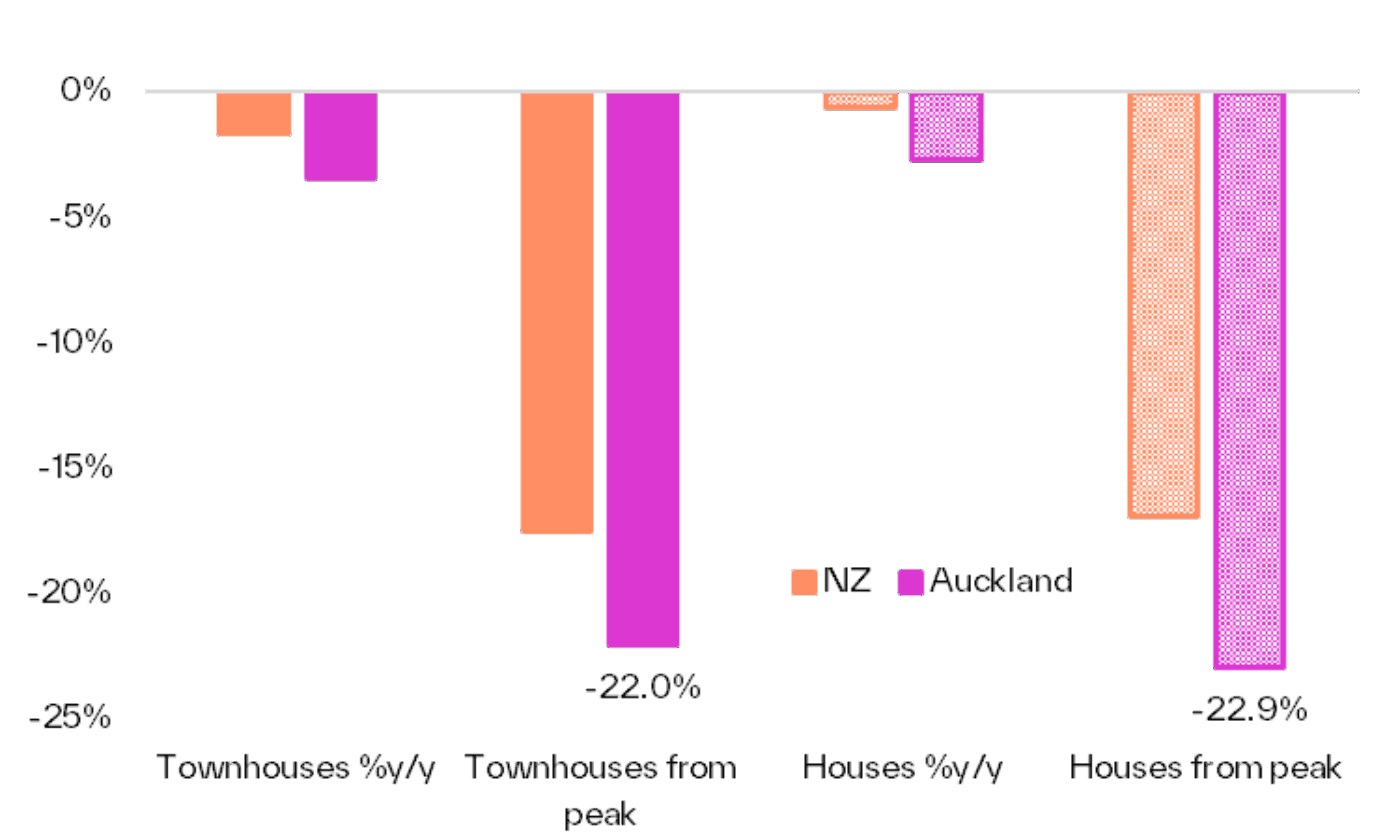
So, townhouses have actually fallen in value slightly less than houses. There’s not much in it.
But if there were a massive oversupply of townhouses, you'd expect the price of townhouses to fall faster than houses.
But they haven't.
But you might think:
“Maybe Auckland doesn't have too many townhouses overall … but what about in the suburbs where developers built lots of townhouses? Maybe there is an oversupply there”
Let’s take a look at Henderson. The number of townhouses there went up 90% over the last 5 years. They almost doubled.
Yet, property values in Henderson fell about 16%.
Compare that to Mount Eden. There have been hardly any new townhouses built there over the same period.
So, you'd expect that house prices there might have held up better. After all, there hasn’t been as much extra housing supply.
Yet Mount Eden house prices fell about 15%.
So, we've got one suburb that almost doubled its townhouse stock. Another that barely added any.
And the difference was 1 percentage point:
That's pretty hard to square with the idea that building lots of townhouses is what caused values to fall.
Last week, I was speaking to an investor who said to me, "I invested in a townhouse. It’s gone down in value. If I just bought a house … this wouldn't have happened."
And what this data shows is that if you’re in this situation, you likely didn’t lose money due to buying a townhouse.
Instead, property prices dropped overall. And buying a different type of property, like a house, might not have made any difference at all.
I get why some people think there’s a glut.
Townhouses are visible. You can see houses being pulled down and new developments being built. So, you notice them when they pop up.
But when we take a step back, you can’t identify a glut in the data.
Cotality also recently released their Pain and Gain report (Q2 2026).
This is where they split property sellers into two groups:
There are two big differences between the groups.
Firstly, far more people made money than lost it. 86.9% of sellers made money, compared to 13.1% who lost money.
But the #1 difference was how long people had owned their property.
The median person who sold for a loss owned their property for just 4.3 years.
The median person who sold for a gain owned their property for 10.4 years.
So those who can hold on for the long term tend to come out ahead of those people who get out of the game early.
Founder, 20+ Years' Experience Investing In Property, Author & Host
Andrew Nicol, Managing Director at Opes Partners, is a seasoned financial adviser and property investment expert with 20+ years of experience. With 40 investment properties, he hosts the Property Academy Podcast, co-authored 'Wealth Plan' with Ed Mcknight, and has helped 1,894 Kiwis achieve financial security through property investment.
This article is for your general information. It’s not financial advice. See here for details about our Financial Advice Provider Disclosure. So Opes isn’t telling you what to do with your own money.
We’ve made every effort to make sure the information is accurate. But we occasionally get the odd fact wrong. Make sure you do your own research or talk to a financial adviser before making any investment decisions.
You might like to use us or another financial adviser


