
Property Investment
What is your dream retirement?
Half of Kiwis don’t have a retirement plan. I think I know why. So, next week, I’m doing something about it. Here’s what we’re launching 👇
Property Investment
2 min read


Author: Andrew Nicol
Founder, 20+ Years' Experience Investing In Property, Author & Host
The rental market has been brutal over the last couple of years.
More rentals were coming up for rent, and fewer tenants were looking.
So, finding a good tenant became much harder.
But it looks like the rental market is starting to flip.
Two years ago, rental searches were down 13%, while new listings were up 14%.
So, more landlords were competing for fewer tenants.
Last year, it was a bit better. 2% more tenants. But still 11% more rental listings.
Today, it’s gone the other way.
Sure, new listings are up 4%. But, tenant demand is up 16% year-on-year.
| Rental searches | New listings | Net direction for landlords | |
| June 2024 | -13% | +14% | -27% |
| June 2025 | +2% | +11% | -9% |
| June 2026 | +16% | +4% | +12% |
That doesn’t mean rents are spiking. After all, this tells you if the market is heading in the right direction for landlords.
But our starting point is still a flat market.
That’s why national rents were up just 1% over the last year (Trade Me, June 2026).
But it is a positive sign. And we’re starting to see landlords take notice.
Tony Alexander’s June 2026 survey shows that a net 29% of investors still say it’s difficult to find a tenant.
That’s an improvement from a net 43% in November 2025 who said it was hard.
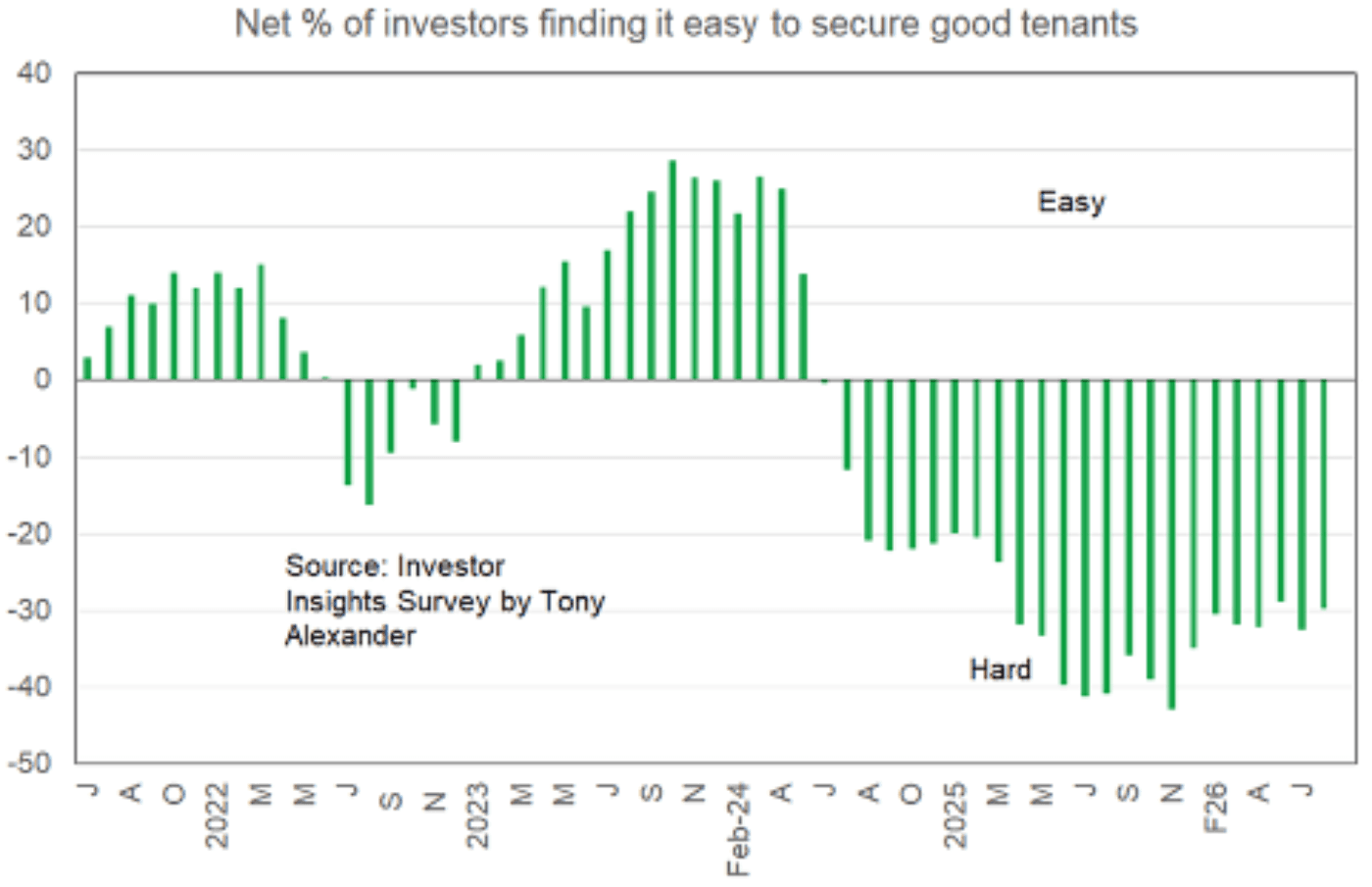
I asked Tony about this last time he was on the Property Academy Podcast. And we talked about how not every property investor is looking for a new tenant every single month.
But Trade Me measures the market every single day.
So while it’s true that the rental market is shifting, not every landlord will be feeling it on the ground today.
You should also keep in mind that the rental market is region-specific.
And in June 2026, we saw that some regions were doing it much tougher than others.
For instance, in Auckland rental searches were up 20%. And there was just a 3% increase in rental listings.
That’s a 17% net change in the landlord’s favour.
But in Taranaki, we saw a 19% increase in tenant demand but a 38% increase in rental listings.
That’s a 19% shift away from landlords.
Here are the numbers for all of the regions in New Zealand:
| Region | Searches | Listings | Percentage point difference in landlord's favour | Moving in the direction of |
| New Zealand | +16% | +4% | +12% | Landlords |
| Auckland | +20% | +3% | +17% | Landlords |
| Bay of Plenty | +16% | +17% | -1% | Tenants |
| Canterbury | +15% | +3% | +12% | Landlords |
| Gisborne | +12% | -16% | +28% | Landlords |
| Hawke’s Bay | +15% | +6% | +9% | Landlords |
| Manawatū-Whanganui | +8% | +9% | -1% | Tenants |
| Marlborough | +11% | +1% | +10% | Landlords |
| Nelson & Tasman | +9% | -1% | +10% | Landlords |
| Northland | +21% | +12% | +9% | Landlords |
| Otago | +13% | +13% | 0% | Even |
| Southland | +2% | +11% | -9% | Tenants |
| Taranaki | +19% | +38% | -19% | Tenants |
| Waikato | +11% | +5 | +6% | Landlords |
| Wellington | +8% | -6% | +14% | Landlords |
| West Coast | -15% | +16% | -31% | Tenants |
New Zealand has gone through flat rental markets before.
In the late 1990s and early 2000s, rents barely moved for just over four years.
The same thing happened after the GFC, when rents stayed largely flat for around three years before picking up again.
Today, rents have been largely flat for about two and a half years.
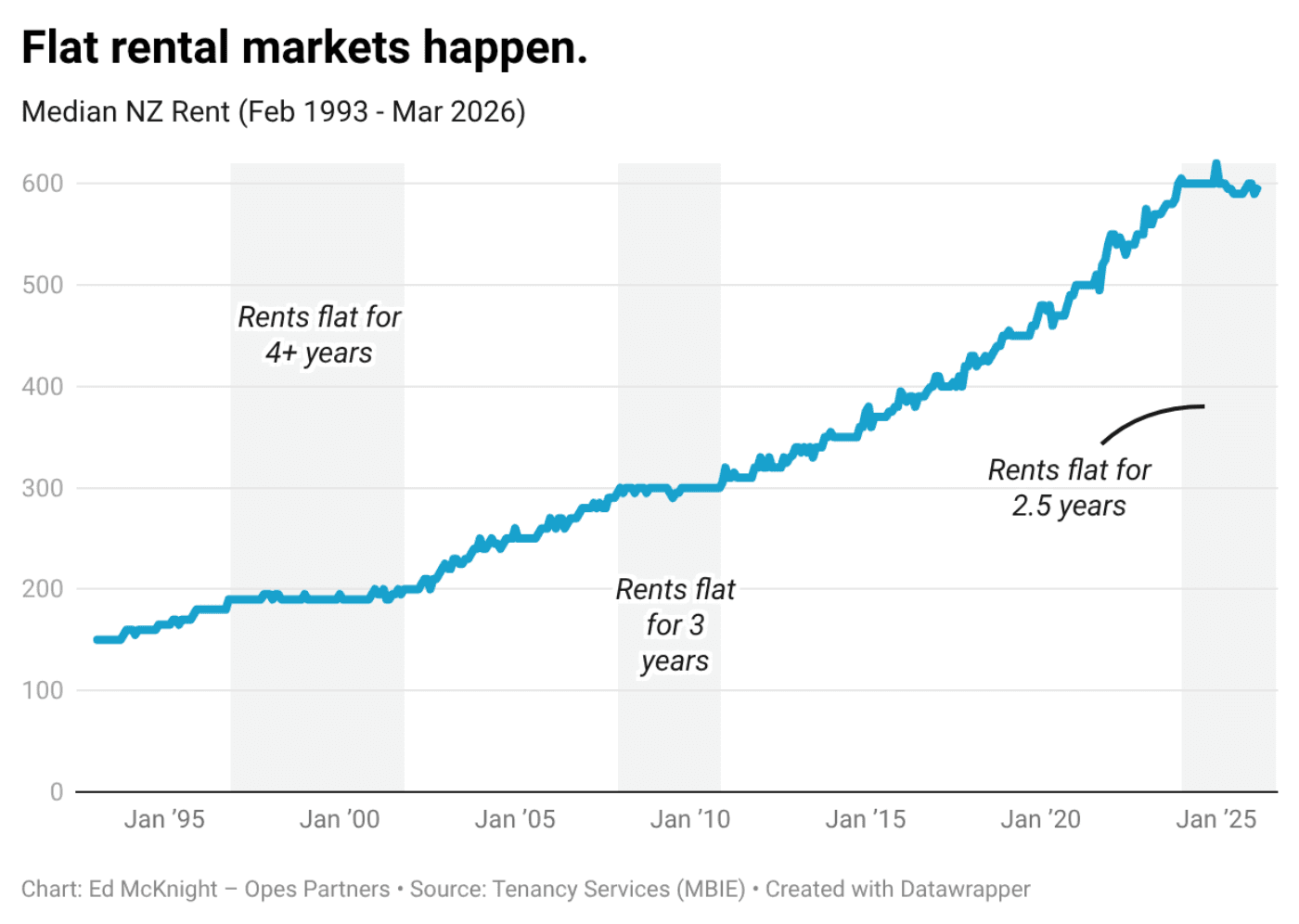
Let me be clear. Rents aren’t rising yet.
But it feels like we could be getting closer to the end of this flat period.
This doesn’t mean landlords can suddenly name their price.
But the balance of power is starting to shift.
Founder, 20+ Years' Experience Investing In Property, Author & Host
Andrew Nicol, Managing Director at Opes Partners, is a seasoned financial adviser and property investment expert with 20+ years of experience. With 40 investment properties, he hosts the Property Academy Podcast, co-authored 'Wealth Plan' with Ed Mcknight, and has helped 1,894 Kiwis achieve financial security through property investment.
This article is for your general information. It’s not financial advice. See here for details about our Financial Advice Provider Disclosure. So Opes isn’t telling you what to do with your own money.
We’ve made every effort to make sure the information is accurate. But we occasionally get the odd fact wrong. Make sure you do your own research or talk to a financial adviser before making any investment decisions.
You might like to use us or another financial adviser


