
Property Investment
OCR is up and we've hit a new bottom of the market
The OCR just went up again. But it's the Reserve Bank’s warning about house prices that really caught my attention 👇
Property Investment
3 min read


Author: Andrew Nicol
Founder, 20+ Years' Experience Investing In Property, Author & Host
Could you predict next year's best-performing property market? The one with the fastest growing property prices?
Here are the returns for each NZ region ranked from best to worst. It covers the last 10 years. But there’s a catch.
Can you spot a pattern in the colours?
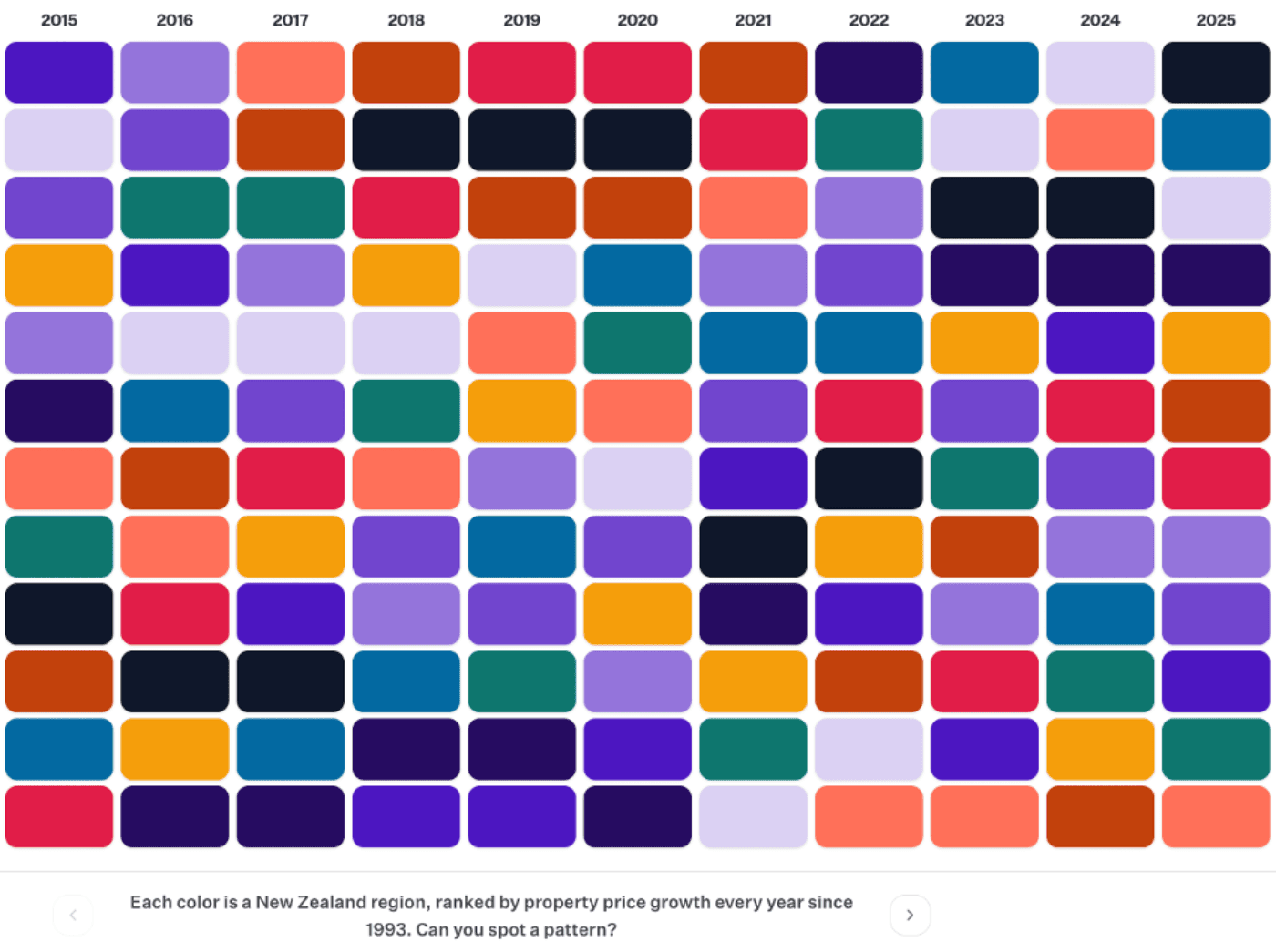
Now, we humans love to see patterns … even if they don’t exist.
But after testing this with many of my team this week, I'm fairly confident to say that most people don't see a pattern.
But, what if I added the region names and the numbers?
Fair warning... this next image is a bit of an eye test.
Can you spot a pattern now?
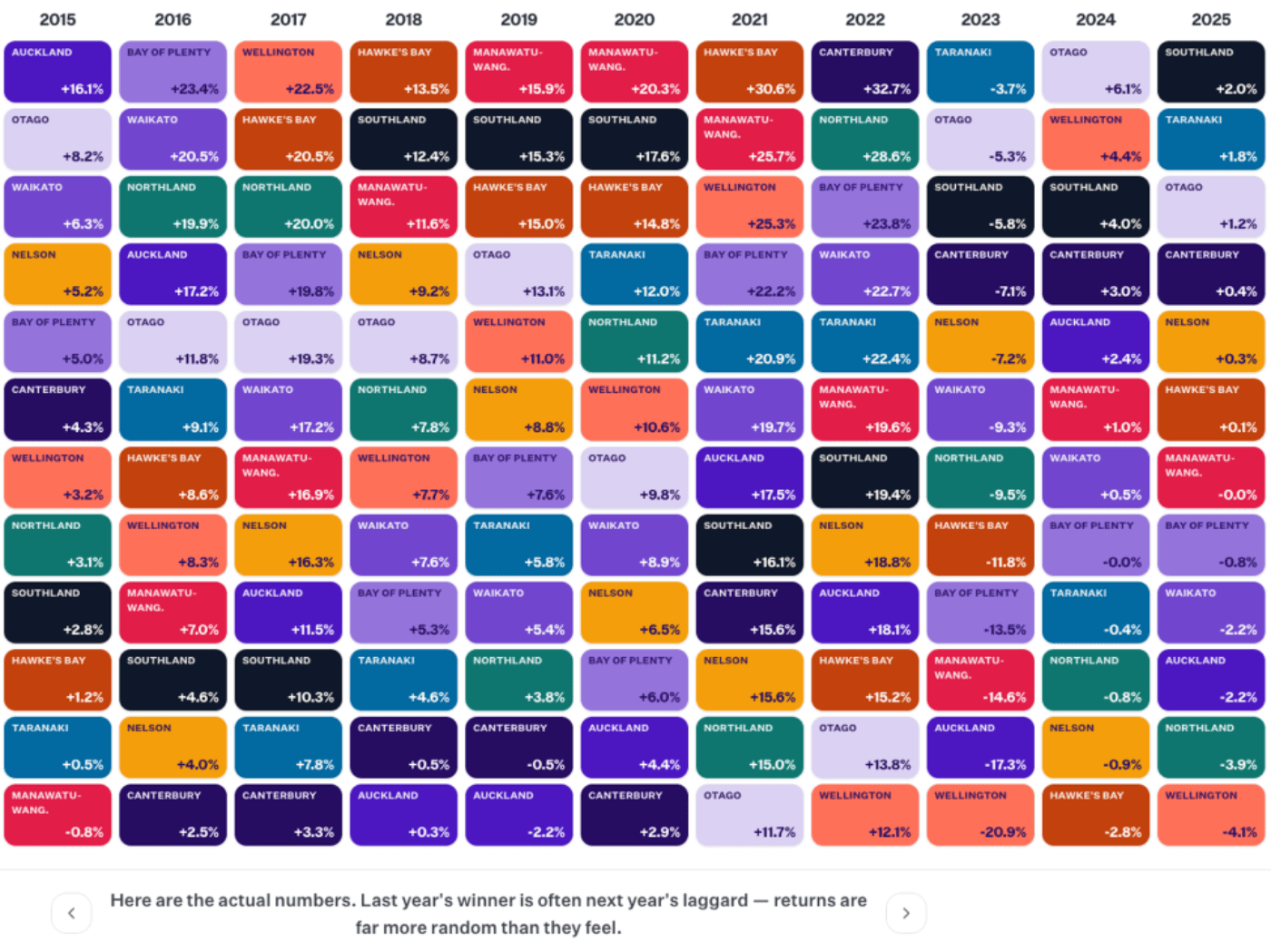
Again, after showing this to my wife, my (young) kids, and my friends. Most people say no.
And that’s my point.
The last few private property newsletters have centred around one major mistake that investors always make:
They look at how fast property prices went up last year, and think those returns will keep on coming.
But from one year to the next, it's almost impossible to pick which region will come out on top.
Now, keep in mind, each region is moving through its own property cycle. And those cycles don't line up.
That’s why I've built calculators like this one. They’re there to understand where each region may sit in that cycle, and where prices look undervalued.
But that only gives a sense of which regions might outperform over the next five to ten years.
In my experience, cycles work over a decade. And are trackable.
But, if you ask me about next year, I honestly have no idea. It’s effectively random.
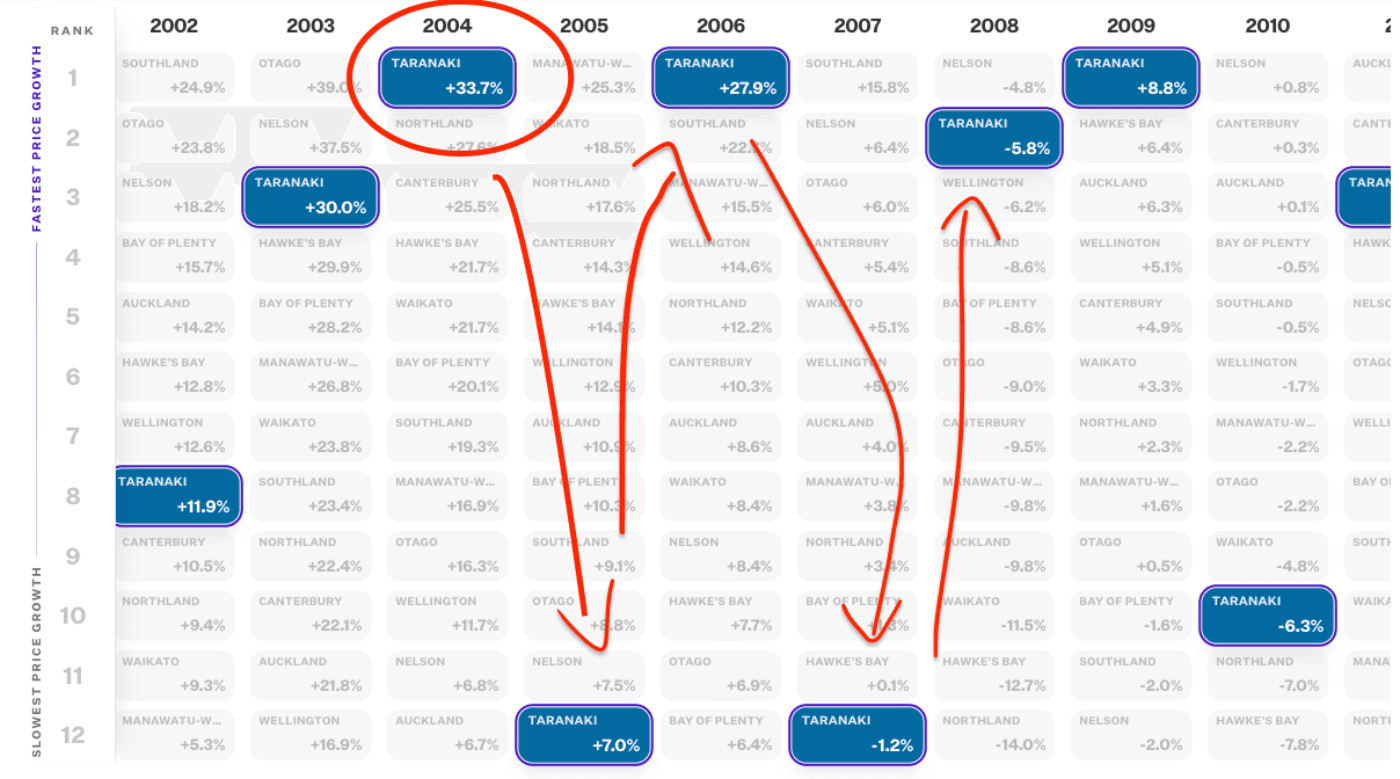
If we look at Taranaki.
In 2005, it was the nation’s hottest property market.
The next year … it was the coldest.
In 2007, it went straight back to the top again.
Then 2008 … banished back to the bottom.
Then what happened the next year? You probably wouldn’t have guessed it. It was back near the top of the charts again.
Auckland is that same mistake in slow motion.
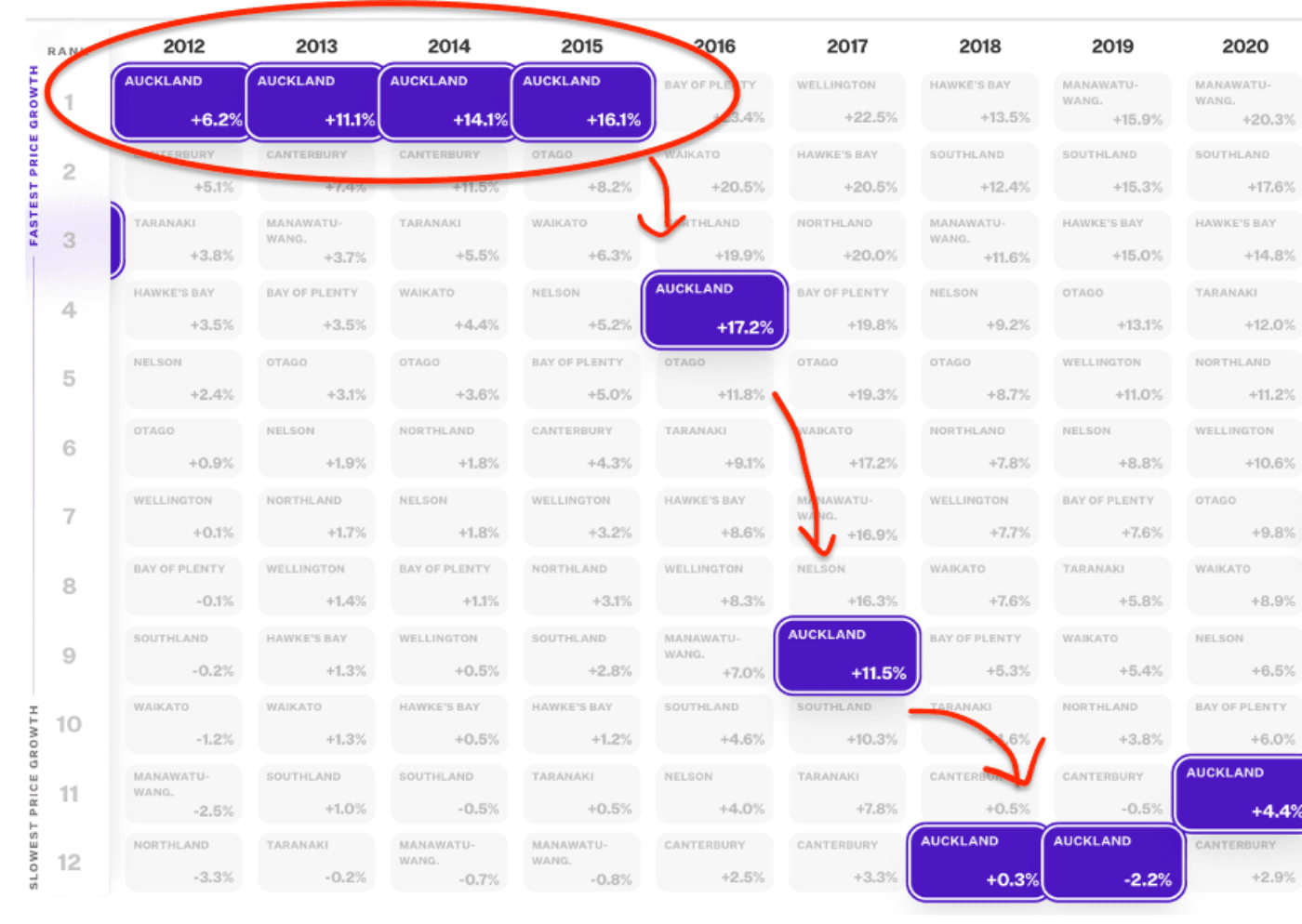
From 2012 to 2015, it was consistently one of the country’s best-performing markets.
It spent 4 years at the top of the rankings.
Then it started sliding.
Fourth.
Ninth.
Last.
Then, last again.
Auckland didn’t suddenly become a bad place to invest.
Its position in the property cycle changed.
That’s the problem with picking a market based only on recent returns.
By the time a region has spent several years near the top, you may be buying after much of the growth has already happened.
If the rankings are constantly changing, how do you actually use this information?
There are 2 points for you to take away.
Firstly, one of my favourite things to do is take complicated data and make it easier to understand.
So I built you this tool to play with the data yourself.
Click on the region you want to track, and watch it move up and down the rankings from 1992 to today.
You'll quickly see one thing.
There is no permanent winner.
And that brings me to the second point, which is that this is why you diversify.
Many investors buy properties all around New Zealand. That way they're not betting everything on one region's cycle turning at the right time.
If one of their properties was a poor performer one year, perhaps that's okay. They might own a property somewhere else that performed well.
And that can smooth out your total portfolio's returns.
That's why I often say to investors to put aside their home bias, investing only where they know. Instead, consider investing further afield too.
Founder, 20+ Years' Experience Investing In Property, Author & Host
Andrew Nicol, Managing Director at Opes Partners, is a seasoned financial adviser and property investment expert with 20+ years of experience. With 40 investment properties, he hosts the Property Academy Podcast, co-authored 'Wealth Plan' with Ed Mcknight, and has helped 1,894 Kiwis achieve financial security through property investment.
This article is for your general information. It’s not financial advice. See here for details about our Financial Advice Provider Disclosure. So Opes isn’t telling you what to do with your own money.
We’ve made every effort to make sure the information is accurate. But we occasionally get the odd fact wrong. Make sure you do your own research or talk to a financial adviser before making any investment decisions.
You might like to use us or another financial adviser


