
Property Investment
Property Investment
3 min read


Author: Andrew Nicol
Founder, 20+ Years' Experience Investing In Property, Author & Host
One political party just dropped a major tax policy for landlords.
Some property investors could see up to $194 extra per week in their bank accounts.
That's if ACT’s new policy gets passed. Here’s how it works.
Here’s how the ACT party’s tax promise works
If I take you back to 2018, here’s how the tax rules used to work.
Let’s say:
That gives you back the extra tax you paid from your normal job.
But then in 2019 the government changed the rules and stopped that from happening. This is what’s known as ring-fencing.
ACT wants to go back to these old rules.
I ran the numbers on a $550,000 investment property.
The property rents for $530 a week, and let’s say you’re borrowing all the money to buy the property.
When you borrow all the money to invest, the rent from the property often doesn’t cover all the costs. So, you need to top up the mortgage from your own pocket.
But if this new policy crosses the line, more of that top-up could be covered by the tax refund.
Here's what the cashflow could look like:
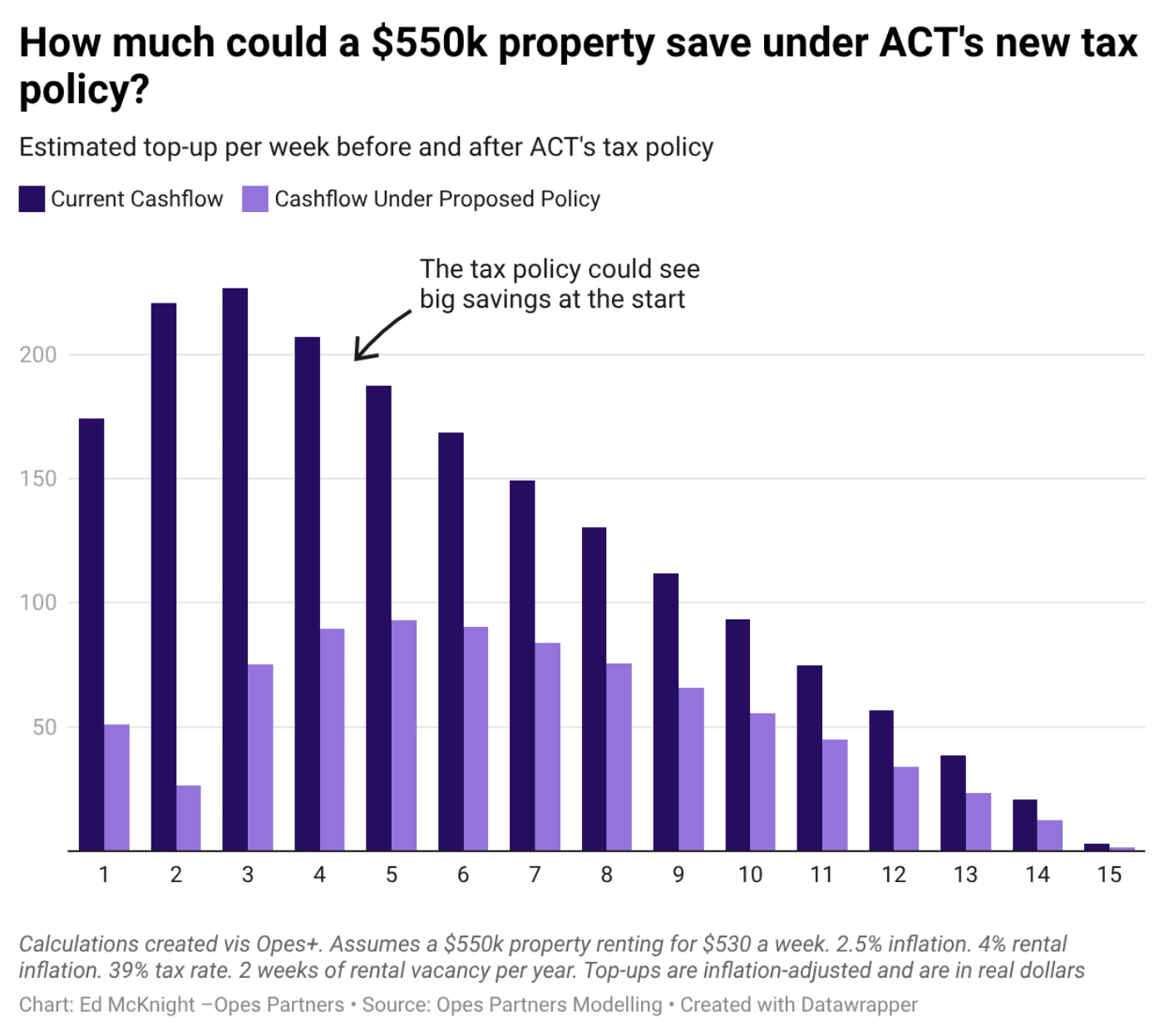
The biggest boost comes in the 2nd year. Rather than topping up the property by $221 a week, that could fall to just $26 a week.
A potential cashflow saving of $194 a week. That’s $10,088 over a year.
That's a big difference.
These tax changes really impact Mum and Dad investors who work normal jobs and own 1 or 2 rental properties.
They’re at the start of investing. They’ve got big mortgages, and they’re waiting for the property’s value and rent to go up.
Their properties require a top-up, so they get a benefit from the policy.
People who have been in the market for decades, with lots of properties, are often at a different stage of investing. They bought their properties cheaply, and the rents have often gone up.
Their properties often don’t need topping up. So, there’s no benefit from the tax change.
Importantly, this tax change would apply to all rental properties, whether they're new or old.
But newer properties do have a slight advantage. That’s because they typically come with newer appliances, carpets and fittings.
These chattels can be depreciated to help give a larger tax refund.
My rough rule of thumb is that this policy typically cuts investors’ weekly top-ups in half.
But there is a slight catch … any losses you've already built up over the last few years don’t qualify. It’d only be for any new losses from after the policy comes in.
This is an election promise. It’s not a change to the law.
ACT would need to get into government, then convince its coalition partners to support the tax change.
Even then, the final rules could look different from what they’re proposing today.
So don't go buying another rental solely because of a tax cut that may never exist.
But if you're already topping up an investment property, it's a policy worth keeping an eye on.
Let me be super clear.
I’m NOT telling you who to vote for.
Because you’re not just a property investor. You could be a parent, grandparent, nurse, teacher, local volunteer.
And when you vote, you vote for a whole set of policies. Not just one proposed change that could benefit one part of your life.
On top of that, property investors come from all sides of the political spectrum. Some tell me they vote for parties that would tax them more.
So the job of this newsletter is to explain a policy that could benefit landlords. But ultimately, you’ll decide who to vote for based on all the policies on offer.
Founder, 20+ Years' Experience Investing In Property, Author & Host
Andrew Nicol, Managing Director at Opes Partners, is a seasoned financial adviser and property investment expert with 20+ years of experience. With 40 investment properties, he hosts the Property Academy Podcast, co-authored 'Wealth Plan' with Ed Mcknight, and has helped 1,894 Kiwis achieve financial security through property investment.
This article is for your general information. It’s not financial advice. See here for details about our Financial Advice Provider Disclosure. So Opes isn’t telling you what to do with your own money.
We’ve made every effort to make sure the information is accurate. But we occasionally get the odd fact wrong. Make sure you do your own research or talk to a financial adviser before making any investment decisions.
You might like to use us or another financial adviser


