Property Investment
The ultimate guide to capital growth
Many property investors and homeowners need capital growth. They rely on house prices increasing, slowly over time, to fund future plans.
Capital Growth
6 min read

Strong population growth doesn't necessarily mean strong capital growth.
We compared population growth and house price growth across New Zealand over the last 30 years.
We found almost no relationship between the two.
The trend actually went slightly the other way. Areas with higher population growth tended to have slightly lower house price growth.
Now, let me be clear. That does not mean that population growth causes lower house prices.
But it does show that population growth alone isn't a good predictor of where house prices will grow fastest.
In this article, you'll learn what the data tells us about population growth and capital growth. You'll also learn why the relationship isn't as straightforward as you might think.
The traditional way of thinking seems sound.
More people = more demand for houses = higher house prices.
A growing population can also be good for a city's long-term prospects.
More people can support more businesses, jobs, infrastructure and amenities. All of these can make an area more desirable.
So it makes sense that property investors often look for areas with strong population growth.
Opes Partners founder, Andrew Nicol says he used to think population growth would have a significant impact on property prices too.
But when you look at what actually happened to house prices over the last 30 years, the relationship isn't as strong as you might expect.
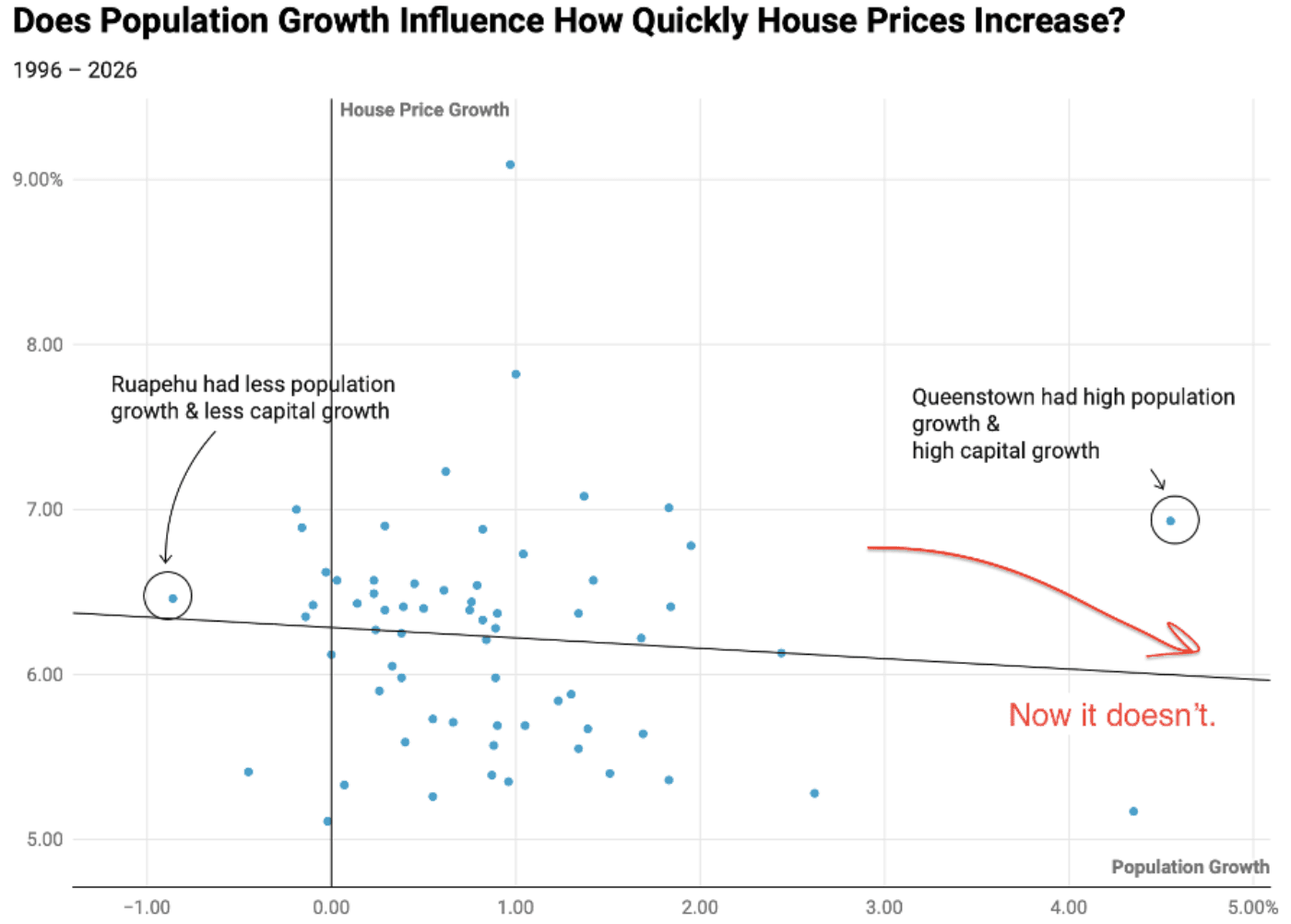
We compared population growth with house price growth across New Zealand's council areas between 1996 and 2026.
Each dot represents a council area.
The further right it sits, the faster its population grew. The higher it sits, the faster its house prices grew.
If population growth was strongly linked with capital growth, you'd expect the dots to generally travel from the bottom left to the top right.
They don't.
The trend line is almost flat. In fact, it slopes slightly downwards.
For every extra 1 percentage point of annual population growth, house price growth was around 0.06 percentage points lower.
Again, that doesn't mean population growth causes lower house prices.
It means population growth tells you surprisingly little about how quickly house prices will rise.
There are two key takeaways from the data.
Our original analysis looked at data between 1996 and 2018. Back then, we found a positive relationship.
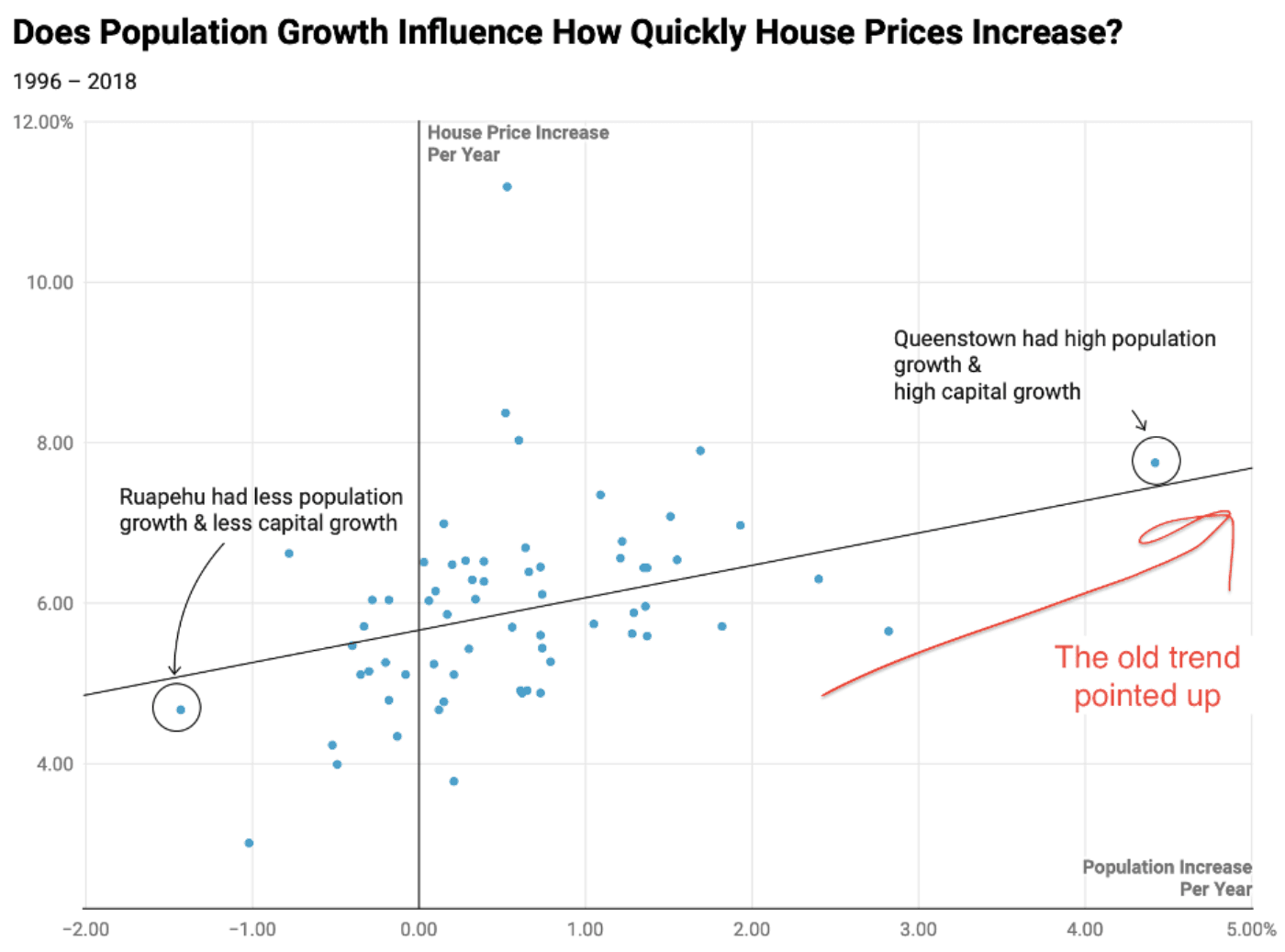
On average, an extra 1% of population growth per year was associated with an extra 0.4% of house price growth per year.
Update the data through to 2026 and that relationship has disappeared.
In fact, it has slightly reversed.
What's changed? Back then our data stopped at 2018. Since then, New Zealand has been through a huge housing boom and downturn. So, adding those extra eight years has changed the long-term results.
But that's also kind of the point, right?
If population growth was a reliable predictor of long-term capital growth ... you'd expect areas with stronger population growth to consistently outperform.
They haven't.
Take our three largest cities:
| Area | Population growth p.a. | House price growth p.a. |
| Auckland | 1.69% | 5.64% |
| Christchurch | 0.87% | 5.39% |
| Wellington | 0.88% | 5.57% |
| New Zealand | 1.23% | 5.84% |
Auckland's population grew almost twice as fast as Christchurch's. Yet its house prices grew only slightly faster: 5.64% a year compared with 5.39%.
It also had faster population growth than New Zealand overall, but lower house-price growth.
The differences become even clearer when you look outside the main centres.
| Area | Population growth p.a. | House price growth p.a. | What happened? |
| Queenstown-Lakes | 4.55% | 6.93% | High population + high capital growth |
| Selwyn | 4.35% | 5.17% | High population + lower capital growth |
| Mackenzie | 0.97% | 9.09% | Lower population + huge capital growth |
| Ruapehu | -0.86% | 6.46% | Population fell + prices still grew |
Queenstown-Lakes does exactly what you'd expect.
Its population grew faster than anywhere else in the country, at 4.55% a year. And house prices grew strongly too, at 6.93%.
So far, so good.
But then you look at Selwyn.
Its population grew almost as fast, at 4.35% a year. But house prices? Just 5.17%.
Then there's Mackenzie.
Its population grew just 0.97% a year. That's below the New Zealand average.
Yet house prices shot up 9.09% a year. That's faster than anywhere else in the country.
And Ruapehu is even more interesting.
Its population actually shrunk by 0.86% a year.
You might expect house prices to struggle too. But they didn't. They grew 6.46% a year.
That's faster than Auckland, where house prices grew 5.64% a year despite the population growing 1.69%.
So yes, sometimes the theory works.
But clearly, there's a lot more going on than just how many people move to an area.
Population growth is only one part of the equation. Yes, it usually increases demand for housing.
But adding a whole bunch more people to an area isn't enough. Two other things matter too.
More people can encourage developers to build more homes.
Selwyn is a good example. Its population grew 4.35% a year. That’s the second-fastest in the country overall.
But Selwyn has also had plenty of land available for new subdivisions and large amounts of new housing built.
That means housing supply has been able to grow alongside the population.
More people wanting houses doesn't automatically send prices soaring.
Those buyers also need the incomes and borrowing power to pay higher prices.
That's why things like employment, wages and the strength of the local economy matter too.
An area could have strong population growth.
But if lots of new houses are being built, there may be enough supply to keep up with demand.
And if incomes aren't rising, buyers may not be able to pay much more anyway.
The opposite can happen too.
An area might have slower population growth. But if there aren't enough houses and buyers can afford to pay more, house prices can still rise strongly.
That's why investors need to look at population growth, housing supply and what people can afford.
All that said, population growth still matters. And there are weaknesses to how we crunched the data for this analysis.
All we did was compare the growth in house prices and population between 1996 and 2026.
Because we’re only looking at those 2 data points, we’re missing out what happened during those 30 years.
For example, if Selwyn District house prices were already relatively expensive in 1996, then we are measuring them off a high base. So the capital growth will look lower.
If, on the other hand, Queenstown house prices were relatively cheap in 1996, then we are measuring them starting off a low base. So the capital growth will look higher.
The upside of doing a simple piece of analysis, like this, is that it’s really easy to understand. But, at the same time, you want to be aware of the limitations as well.
Because the truth is, more people generally mean more demand for housing. On top of that, growing cities can also have stronger economies, more jobs and more amenities. Rolleston (the main city in Selwyn District) used to have just 2,000 people living there. Now it has 30,000.
That higher population makes the housing market more stable than it would have been in the past.
But what the data does say to us is that investors shouldn't use population growth on its own to decide where to invest.
Investors need to be asking:
Population growth creates demand. It doesn't decide what happens to house prices.

Resident Economist, with a GradDipEcon and over five years at Opes Partners, is a trusted contributor to NZ Property Investor, Informed Investor, Stuff, Business Desk, and OneRoof.
Ed, our Resident Economist, is equipped with a GradDipEcon, a GradCertStratMgmt, BMus, and over five years of experience as Opes Partners' economist. His expertise in economics has led him to contribute articles to reputable publications like NZ Property Investor, Informed Investor, OneRoof, Stuff, and Business Desk. You might have also seen him share his insights on television programs such as The Project and Breakfast.
This article is for your general information. It’s not financial advice. See here for details about our Financial Advice Provider Disclosure. So Opes isn’t telling you what to do with your own money.
We’ve made every effort to make sure the information is accurate. But we occasionally get the odd fact wrong. Make sure you do your own research or talk to a financial adviser before making any investment decisions.
You might like to use us or another financial adviser