
Property Investment
What is your dream retirement?
Half of Kiwis don’t have a retirement plan. I think I know why. So, next week, I’m doing something about it. Here’s what we’re launching 👇
Property Investment
3 min read


Author: Andrew Nicol
Founder, 20+ Years' Experience Investing In Property, Author & Host
I was lounging on my couch on Saturday when I opened up the NZ Herald and saw something interesting.
Mary Holm – one of New Zealand’s most trusted financial writers – talking about us at Opes Partners.
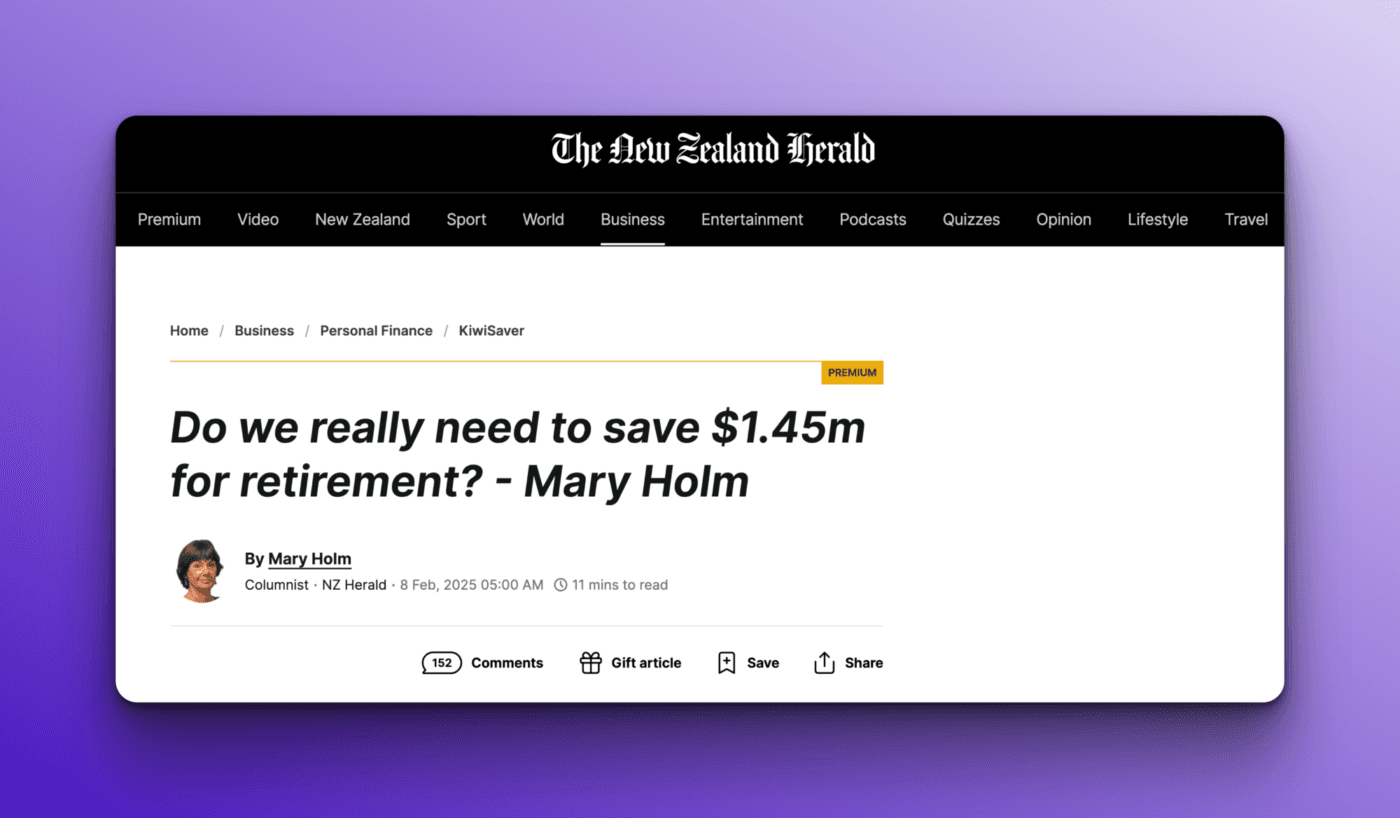
A reader was on my website looking at an article. It was talking about how much you might need for retirement.
They thought my numbers looked a bit high. Mary agreed (nothing wrong with that).
After all, I really like and respect Mary. But there are a few things she (and others) often miss when it comes to retirement numbers.
If you want to live the Choices lifestyle in retirement (I talked about this in last week's newsletter), I reckon you might need $890k - $1.45 million.
Massey University’s equivalent report said $717k - $969k.
Why are my numbers higher?
One reason is how you set up your money:
If you want to live off the returns … you’ll need more savings.
If you want to inflation-proof your retirement, you need more savings.
If you don’t want to rely on NZ Super, you need more savings.
I love Massey University’s report. But, they take one view:
That’s why I give people a bigger range. Because the amount you need isn’t a single number. It depends on how you want your retirement to look.
By the time my wife retires, she’s got a 24% chance of living to 100.
And there’s a 50% chance she’ll live to 93.
Knowing her, she’ll live to 110.
But Massey University’s report assumes you and your partner die at 90.
Not a bad assumption if you’re currently 65.
But younger generations tend to live longer.
Again, that’s why I give a wider range than Massey University.
Because if you’re younger, you don’t want to run out of money in your later years.
The other big difference is that reasonable people will use different numbers in their calculations.
For instance, how much will a Balanced Fund return you each year?
Some people say as little as 3.5%. Others will say up to 6% or more.
That’s why I paid MyFiduciary – an investment consultancy – to tell me what to use. They said 4.43%.
If you assume your investments get a higher return … you’ll need less money to retire.
If you think your investments get a lower return … you’ll need more money.
That’s part of the difference between my and Massey’s numbers.
I’m not knocking everything Mary wrote. She made some good points.
As people get older, they tend to spend less.
Neither my nor Massey University’s numbers take that into account.
That’s primarily because no one’s done much research on that question.
But, what I do think Mary gets wrong is saying things like:
“Opes numbers are higher than FinEd’s, which is hardly surprising given they want to encourage people to invest.”
She’s right that I want to encourage people to invest … but not for some untoward selfish reason, as Mary insinuates.
It’s because most Kiwis I meet – as a financial adviser – are not on track for the retirement lifestyle they want.
And, as a financial adviser – I want to put out accurate numbers. That’s why I give a range.
So, my podcast, book, and newsletter aren’t here to give you one single number for what to aim for in retirement.
They’re here to give you the options so you can make up your own mind.
Founder, 20+ Years' Experience Investing In Property, Author & Host
Andrew Nicol, Managing Director at Opes Partners, is a seasoned financial adviser and property investment expert with 20+ years of experience. With 40 investment properties, he hosts the Property Academy Podcast, co-authored 'Wealth Plan' with Ed Mcknight, and has helped 1,894 Kiwis achieve financial security through property investment.
This article is for your general information. It’s not financial advice. See here for details about our Financial Advice Provider Disclosure. So Opes isn’t telling you what to do with your own money.
We’ve made every effort to make sure the information is accurate. But we occasionally get the odd fact wrong. Make sure you do your own research or talk to a financial adviser before making any investment decisions.
You might like to use us or another financial adviser


