
Property Investment
Property Investment
3 min read


Author: Andrew Nicol
Founder, 20+ Years' Experience Investing In Property, Author & Host
The first OCR announcement of the year just dropped. No change to the OCR. It’s staying put at 2.25%.
No surprise there.
However, there was a surprise you need to pay attention to. Although the OCR didn’t change, the Reserve Bank’s tone absolutely did.
And that matters A LOT in the interest-rate world. Here’s what it means for you.
Now, remember the Reserve Bank has two main modes:
The last OCR announcement in November came across as hawkish. That spooked the markets, and mortgage rates crept up.
Especially because inflation is sitting at 3.1%. That’s just outside of their target 1-3% band.
But, this time? … The market is interpreting the announcement as slightly dovish.
The Reserve Bank Governor said: “The Committee is confident that inflation will fall to the 2% midpoint over the next 12 months”
Because of that, she expects that interest rates will “remain accommodative” for a while.
That’s hardly sexy talk for most. But to people who watch markets for a living? That’s a wink, wink, nudge, nudge.
But why isn’t the Reserve Bank worried? Well, a big chunk of inflation is coming from administered inflation. That’s things like council rates and electricity.
Administered inflation is sitting at 8.7% (vs 3.1% for overall inflation).
Raising the OCR won’t change any of that. Councils don’t dial down rates because the OCR goes up. They just set their budgets and send you the bill.
So, the Reserve Bank is watching what it can control.
And we can see the market interpreting this as dovish based on what happened overnight.
Immediately after the announcement, wholesale rates dipped. (Think of these as what it costs banks to borrow and lend money to you and me for our mortgages.)
Yes, tiny moves. And yes, they could be reversed in a week.
But the direction matters. Last time swap rates rose because the RBNZ sounded aggressive.
This time? They went the other way.
Today – today and tomorrow – not much will change.
The floating rates are tied to the OCR. And the OCR didn’t budge.
The fixed rates are tied to the swaps. And those went down a bit (but don’t expect a cheaper interest rate).
6-12 months – The markets think we’ll get 1-2 OCR increases by this time next year.
Just remember that mortgage rates tend to move before the OCR does.
So, as we get closer to the next expected increase, fixed rates will start creeping up.
2 years – Over the next two years, the OCR is expected to drift back to around 3%.
If that happens, 1-year mortgage rates will likely settle around 5%.
I was scrolling through the Stuff.co.nz comments (dangerous hobby, I know).
One commenter, Tony_49, declared the Reserve Bank has “no clue whatsoever” and inflation will definitely still be above 5% next year.
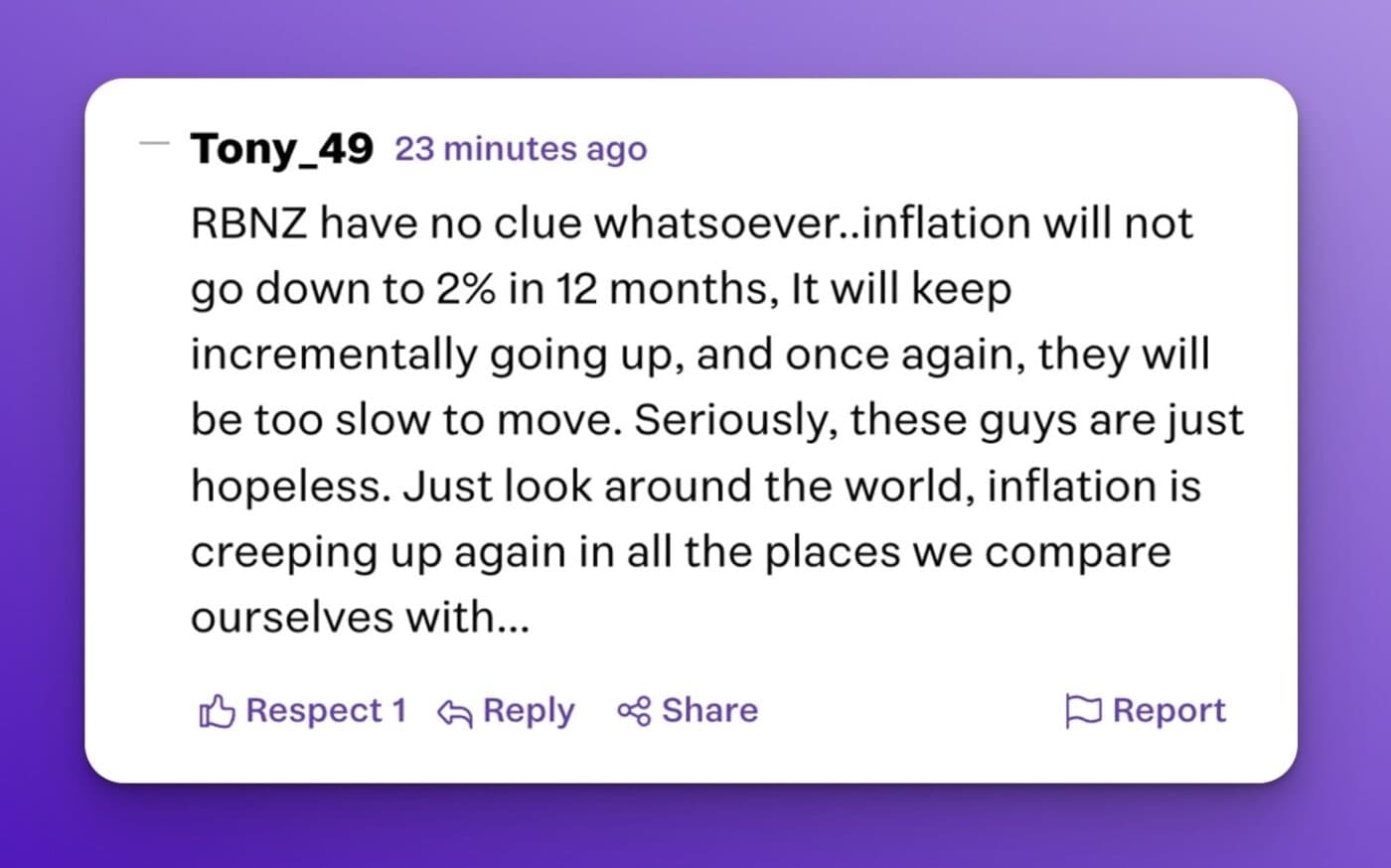
And that reminded me of a graph that caught my eye. It was buried deep in the Reserve Bank’s docs. And it shows how much inflation the average Joe on the street expects … and professional forecasters.
In one year:
It’s a trend we’ve seen over the last 9 years.
The people setting prices think inflation is heading back toward the target.
The people paying those prices think it’s not.
So can we trust that inflation will just sort itself out? Well… it depends on whether you side with the economists. Or Tony_49.
Founder, 20+ Years' Experience Investing In Property, Author & Host
Andrew Nicol, Managing Director at Opes Partners, is a seasoned financial adviser and property investment expert with 20+ years of experience. With 40 investment properties, he hosts the Property Academy Podcast, co-authored 'Wealth Plan' with Ed Mcknight, and has helped 1,894 Kiwis achieve financial security through property investment.
This article is for your general information. It’s not financial advice. See here for details about our Financial Advice Provider Disclosure. So Opes isn’t telling you what to do with your own money.
We’ve made every effort to make sure the information is accurate. But we occasionally get the odd fact wrong. Make sure you do your own research or talk to a financial adviser before making any investment decisions.
You might like to use us or another financial adviser


