Property Investment
What are the top 8 best investments in New Zealand?
Explore the top 8 investment options in New Zealand, including property, KiwiSaver, shares, and more. Get insights on the pros and cons to make better financial decisions.
Property Investment
6 min read

Author: Nefe Marson
Financial adviser at Opes. Formerly a senior adviser at one of NZ largest investment firms. Owned 3 properties by 30.
Reviewed by: Derry Brown
Financial Adviser in industry since 2007. Investor in Auckland & Christchurch. Previous COO of Global Brand
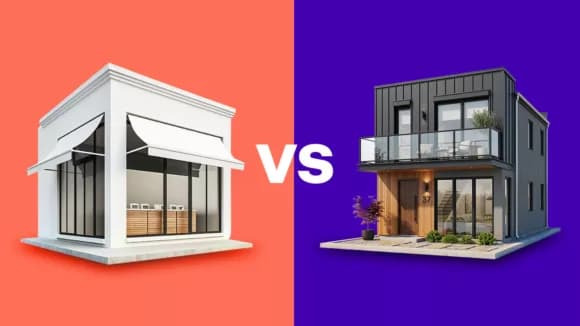
Should you buy a business or an investment property?
Before you decide to invest in either, you need to answer these 6 questions:
I was reminded of this because I recently worked with an Otago couple.
They were pre-approved to spend $650k on an investment property. They looked at properties with their financial adviser, and the numbers seemed to make sense.
But then they spoke to their business adviser who told them the yield on the property wasn’t good enough. The business adviser suggested buying a business instead.
But deciding between a business and a property isn’t as simple as comparing yields.
Before we get into it, you might think: “Nefe, you help people invest in property. Aren’t you just going to tell me that property is the best?”
I’m not going to do that. This will be an honest comparison of the pros, cons and returns of buying a business vs. an investment property.
Here’s a summary of the main differences. Just keep in mind this is what I see most of the time (the exact numbers can change):
| Investment Property | Business | |
| Average cost | $772,000 (March 2025) | $769,000 (April 2024 – March 2025) |
| Deposit required | 20 - 30% | 30 - 50% |
| Interest rates | 4.5 - 5% Standard mortgage rates | 5 - 12% Risk-based pricing |
| Loan term | 30 years (max) | 5–10 years |
| Time commitment | Mostly passive | You work full-time in the business (most of the time) |
| Net yield (Before mortgage costs) | 3-4% | 10-30% |
| Risk | Medium-high | Very high |
Property and businesses can cost a similar amount to buy. But the risk, workload, and lending terms are very different.
Properties and businesses can sell for around the same price
Let’s say you’re like the couple I mentioned earlier and you want to invest $600,000.
For $600,000 you could buy a New Build townhouse in Christchurch. Or, if you look for businesses for sale on Trade Me or a business brokerage site, you might find:
These are real, tangible businesses.
If you buy a $600,000 investment property, you typically need a 20-30% deposit.
That means you’d need a $120,000-$180,000 deposit to buy a $600,000 investment property.
Buying a $600,000 business can look very different.
Banks are usually more cautious lending against businesses and may need you to put in a 30-50% deposit.
That means to buy a $600,000 business you might need $180,000-$300,000 of your own money.
Getting a loan to buy a business is usually harder than getting a loan for a property.
| Property loan | Business loan | |
| Interest rates | 4.5 - 5% Standard mortgage rates | 5 - 12% Risk-based pricing |
| Loan term | Up to 30 years | Often 5-10 years |
| Servicing | Based mainly on your income and debts | Based on business past profits and forecasts |
The biggest difference is how banks set the interest rate.
With property most borrowers pay similar mortgage rates. With businesses, the bank adjusts the rate depending on how risky the business appears.
A bank might be comfortable lending to a childcare centre and offer a lower rate, but petrol stations might be considered riskier. That means they might have to pay a higher interest rate.
Banks also check if the business can afford the loan by reviewing:
But business loans are usually shorter: 5-10 years compared with up to 30 years for property.
That means even if a business looks like it produces a higher return, the loan repayments can still be much higher.
Businesses tend to generate a higher return than properties. One way to compare properties and businesses is by looking at the net yield.
Net Yield = (Revenue – Costs) / Asset Value
But this is before taking into account any debt.
So if a property costs $600,000, earns $30,000 a year in rent and has $10,000 in operating costs, then:
($30k - $10k) / $600k = 3.3% net yield.
This calculation is a little harder for businesses because the value of a business can fluctuate.
But according to ABC Business Sales, the average small business sells for 3.5x its earnings (EBITDA).
That suggests an average business earns a net yield of 29%.
Of course, there are other things to consider like:
However, it’s fair to say that typically businesses get a higher net yield than properties.
Businesses will often take up much more of your time than property.
When you buy a business around that $600,000 mark it usually won’t have a management team.
You are often buying a business and a job at the same time.
The MBIE Small Business fact sheet shows 72% of all New Zealand businesses have zero employees. That means the owner is doing everything.
That motel business listed for $500k? It often includes owner accommodation because you’ll be the one running it.
That liquor store? You’ll likely be rostering staff, ordering stock and working weekends.
I once looked into buying a liquor store as a side investment to generate extra income, but after speaking to an experienced owner, I realised it wasn’t for me. Most stores at that level only generate around $80,000 in owner income, and many franchisors expect you to be an owner-operator.
To buy a business that runs without you, you’d usually need much more than $600k, so you’re also buying the systems, staff and management.
By contrast investment property can be relatively passive. With a property manager in place, most investors spend very little time managing it.
Investment properties (especially with debt) are medium to high risk, but businesses are even riskier.
When a business fails, its value can drop to zero.
According to Stats NZ, only 46% of businesses started in 2019 were still operating five years later. That means more than half closed within five years.
Things are also getting tougher. The Companies Office recorded 2,867 company liquidations in 2025, the highest number in 15 years.
You’ll even see businesses listed for sale for $1, where the owner simply wants someone to take over the lease and liabilities.
Property values tend to be more stable. Even during downturns the value of the property rarely goes to $0.
But businesses do have one advantage: the upside can be huge. If you grow the revenue of a business you can dramatically increase its value. That’s something you can’t easily do with a residential property.
Buying a business isn’t the right move for everyone. And both property and business might not be the right fit for you if you have a low risk tolerance.
Buying a business tends to suit people who are comfortable with risk and have the skills and experience to manage it.
| Investment property may suit you if you: | Buying a business may suit if you: |
want a relatively passive investment value stability and long-term growth | are comfortable with higher risk have industry experience want to actively run and grow a business |
And many successful investors eventually invest in properties and businesses.
That’s why the right choice depends on what you’re trying to achieve.
If you’re considering buying a business:
If you’re thinking about property:
Get a personalised wealth plan based on your goals and financial situation - no cost, no obligation.
Book your free sessionFinancial adviser at Opes. Formerly a senior adviser at one of NZ largest investment firms. Owned 3 properties by 30.
Nefe is a Registered Financial Adviser at Opes Partners with 7 years’ experience in financial services. Before joining Opes, she was a senior adviser at one of New Zealand’s largest investment firms, managing $13 million in KiwiSaver and managed funds. She’s helped clients invest over $26 million in property and owned 3 properties before her 30th birthday.
This article is for your general information. It’s not financial advice. See here for details about our Financial Advice Provider Disclosure. So Opes isn’t telling you what to do with your own money.
We’ve made every effort to make sure the information is accurate. But we occasionally get the odd fact wrong. Make sure you do your own research or talk to a financial adviser before making any investment decisions.
You might like to use us or another financial adviser