
Property Investment
Property Investment
3 min read


Author: Andrew Nicol
Founder, 20+ Years' Experience Investing In Property, Author & Host
Is there a new “leaky homes crisis” brewing in New Zealand?
This headline appeared in the Herald last week: A third of New Builds in Auckland are failing their final inspections.
I read that. And almost spat out my coffee.
After all, I run a business that helps investors buy New Builds.
So, if there’s lots of bad buildings going up … I want to know about it.
How could this happen, right under my nose?
So, I’ve dug into the data. Let’s get our detective hat on to see if the headline is accurate.
After digging into the data … that number is true.
1 in 3 New Builds in Auckland really do fail their (first attempt at) final Auckland Council inspection.
What image does it conjure up in your mind when you hear that?
Has there been a sudden spike in shoddy building work?
Perhaps you’re picturing builders throwing up New Builds at any cost … just to make a quick buck in the property boom.
Maybe you’re picturing the sudden decline of the building industry. The ditching of long-held high standards.
Actually. When you look at the data, it’s the opposite.
Auckland Council doesn’t publish a consistent data series about how many New Builds fail their inspection.
But they do give snapshots in reports and mention the latest number in the media.
Here are the fail rates I found:
So, more New Builds are passing their final inspection in 2025 compared to 2013.
So, the quality of NZ building is getting better, rather than worse.
*The 2015 number is a bit misleading. The council changed how they counted failure rates in 2015. But switched back the next year. So you can ignore this number.
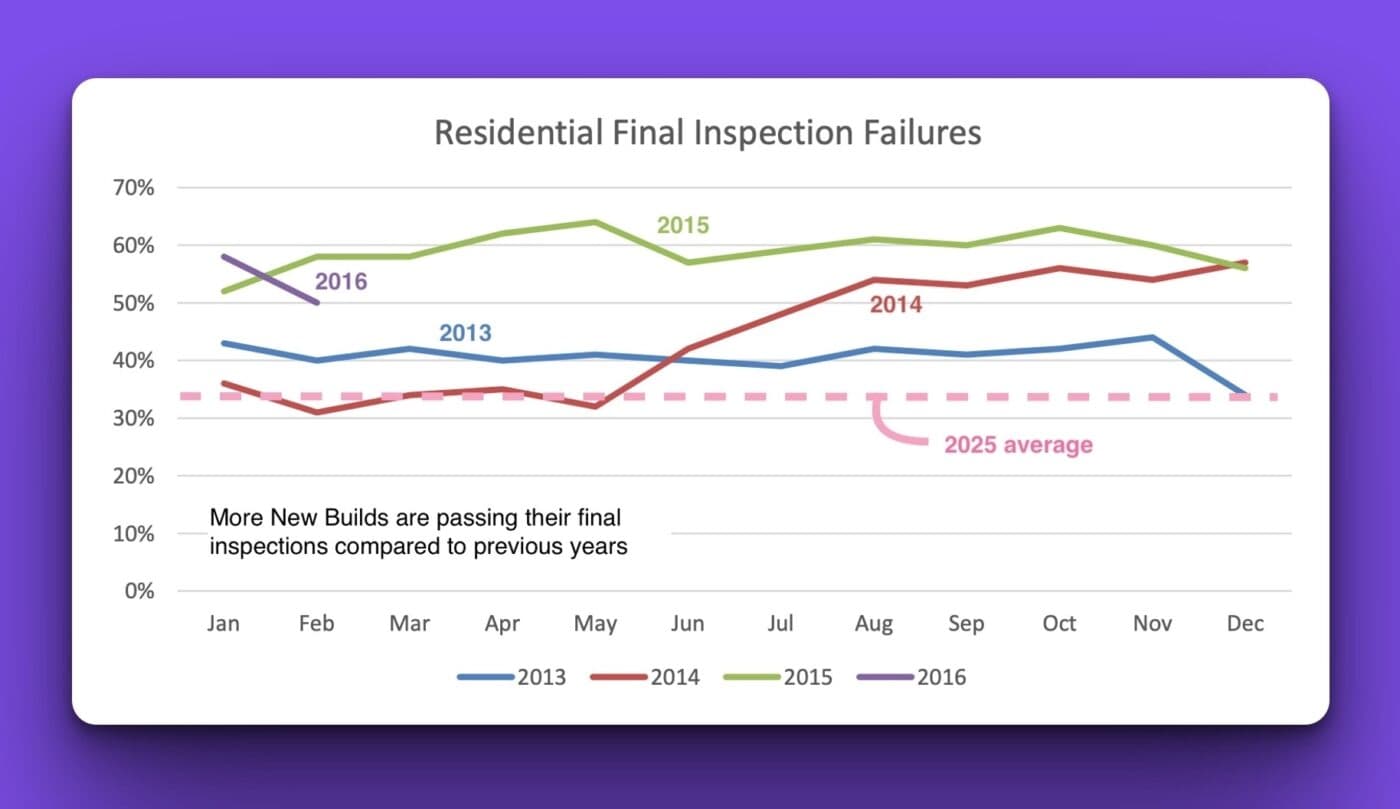
That paints a very different picture than you might have thought.
And that’s why whenever you read an article – whether mine or the Herald’s – you need to ask: “What does that REALLY mean?"
If you see a scary stat ask: "What is it measuring? And how does it compare to the past?”
But hang on a second.
That 33% failure rate still sounds scary. So what’s going on? What does that number measure?
Before a person moves into a new property … builders need to get the council’s sign off.
So in the lead up to completion, many developers get the council in early to see what’s left to fix.
It’s better to get the council in early to see what they’ll pick up, rather than leaving it to the very last minute.
So that failure rate really measures the first attempt at a final inspection.
It doesn’t mean that a third of properties can’t pass at all. But that things get picked up on the first attempt at the final inspection.
Now, let me be clear.
It’s not that all builders are angels. I’m not saying ‘nothing ever goes wrong’.
Things do go wrong.
Not every builder has your best interest at heart.
That’s why I’ve included 3 developer horror stories in this week's articles.
And, I don’t mean to say that the entire news industry is bad.
After all, the Herald published this article just this morning. It’s a story about a young, up-and-coming investor called Andrew Nicol (that's me).
But we must be fair, review the facts, and put things in perspective.
And that headline saying: 1 in 3 New Builds fail their final council inspection ...
While it sounds like the state of NZ’s buildings is getting worse, the numbers show that’s not true.
It turns out that news, wasn’t really news at all.
It only told half the story.
Founder, 20+ Years' Experience Investing In Property, Author & Host
Andrew Nicol, Managing Director at Opes Partners, is a seasoned financial adviser and property investment expert with 20+ years of experience. With 40 investment properties, he hosts the Property Academy Podcast, co-authored 'Wealth Plan' with Ed Mcknight, and has helped 1,894 Kiwis achieve financial security through property investment.
This article is for your general information. It’s not financial advice. See here for details about our Financial Advice Provider Disclosure. So Opes isn’t telling you what to do with your own money.
We’ve made every effort to make sure the information is accurate. But we occasionally get the odd fact wrong. Make sure you do your own research or talk to a financial adviser before making any investment decisions.
You might like to use us or another financial adviser


