
Property Market
What's happening with NZ house prices right now?
Get the latest insights on New Zealand’s property markets, including trends, growth areas, and investment opportunities across regions.
Property Investment
6 min read


Author: Ed McKnight
Resident Economist, with a GradDipEcon and over five years at Opes Partners, is a trusted contributor to NZ Property Investor, Informed Investor, Stuff, Business Desk, and OneRoof.
Reviewed by: Laine Moger
Journalist and Property Educator, holds a Bachelor of Communication (Honours) from Massey University.
The best places to invest in property in New Zealand right now are:
The city you choose matters a lot.
In many cases, it matters more than the property itself.
Here at Opes Partners, we help more than 500 investors buy New Build properties each year.
So, we keep a close eye on where the numbers look strongest.
In this article, you’ll learn the 5 places we rank highest right now, and the reasons why.
| Places | Property Cycle 1 | Yield 2 | Population growth 3 | Average house price 4 | Capital growth 5 |
| Auckland | 9.48% undervalued | 3.1% | Strong +33% | $1.01m | 4.85% |
| Christchurch | 3.63% undervalued | 4% | Steady +15% | $795k | 4.56% |
| Rolleston (Selwyn District) | 0.72% undervalued | 4.1% | Strong +47% | $780k | 5.93% |
| Kaiapoi & Rangiora (Waimakariri District) | 3.59% undervalued | 4.4% | Steady +25% | $735k | 4.29% |
| Whangārei | 4.35% undervalued | 4.2% | Steady +20% | $736k | 5.53% |
Undervalued by 4.35%
Yield: 4.2%
Population growth: Steady +20% projected for the next 25 years
Whangārei is home to about 100,000 people. That means there are a reasonable number of tenants to rent to, and buyers when you want to sell.
From our numbers, prices are still about 4.35% below where we’d expect them to be at this point in the market cycle (March 2026).
Over the next 25 years, Whangārei’s population is forecast to grow about 20%, according to Stats NZ population projections.
That’s not huge … but it’s steady.
The median house price is around $736,000, which is cheaper than many bigger centres. Because prices are lower, rental returns are often stronger than places like Wellington.
The downside is that Whangārei has a smaller economy than the big cities.
But as a balance between affordability, yield, and growth, it earns its place on the list.
| Pros | Cons |
Still a bit undervalued House prices are lower than many of the big cities Often has better rental returns than Wellington | Smaller local economy Fewer high-paying jobs Slower population growth than top spots |
Undervalued by 3.59%
Yield: 4.4%
Population growth: Steady +25% projected for the next 25 years
These two Canterbury towns in the Waimakariri District are grouped together because they have a lot in common.
They’re close to Christchurch. That means people can work in Christchurch (often for higher pay) but live somewhere cheaper. That helps keep rentals in demand and supports house price growth over time.
House prices in Waimakariri appear 3.59% below where we would expect them to sit at this point in the property cycle.
That suggests there is a buying opportunity in Waimakariri.
The median house price is $735,000. Average household income is around $120,000.
On top of that, the population is forecast to grow about 25% over the next 25 years.
For investors, these towns work well as “near-the-city” markets e.g. close to a big city, but cheaper to buy in.
| Pros | Cons |
| Still a bit undervalued Close to Christchurch jobs Affordable prices, good local incomes | Depends on Christchurch’s economy Smaller tenant pool than a bigger city Growth can put pressure on roads, schools, and services |
Undervalued by 0.72%
Yield: 4.1%
Population growth: Strong +47% projected for the next 25 years
Rolleston sits on the other side of Christchurch, in the Selwyn District.
Selwyn is forecast to be the fastest-growing district in New Zealand, up about 47% over the next 25 years.
More people moving in means more demand for housing.
But there’s a catch: a lot of new homes have been built in the area (especially in Rolleston). That has pushed prices up, and it has made rental returns weaker than they used to be.
The median house price is now $780k.
So Selwyn isn’t “cheap” anymore. But the reason it still makes this list is that lots of people want to live there. So the population growth is so strong.
About 30 years ago less than 2,000 people lived in Rolleston. Now over 34,000 people call the city home.
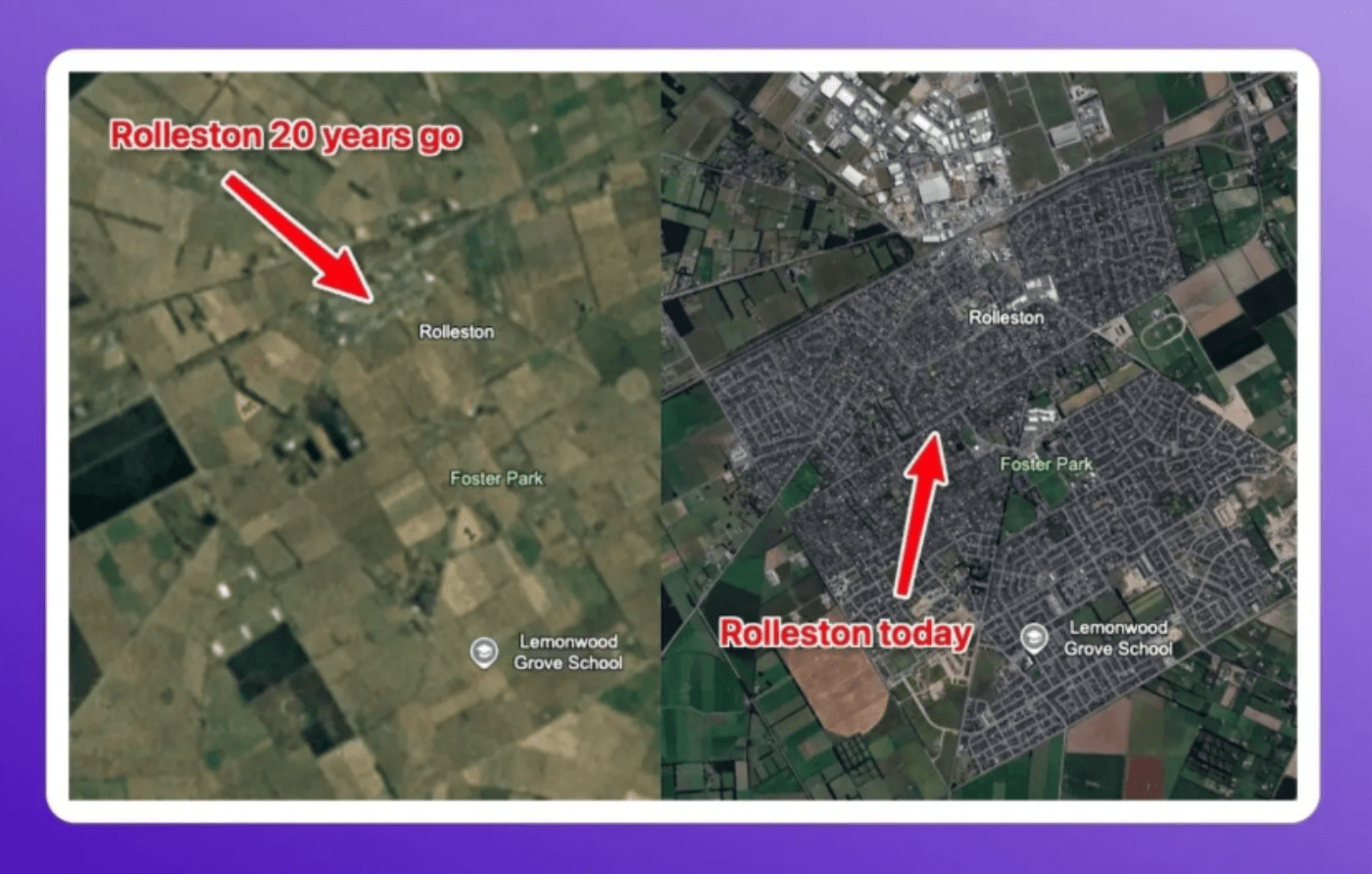
It’s not a “farm town” anymore. It’s very much the city it’s been promising to be for a while.
If you want long-term growth and stability, you might consider investing in Rolleston.
| Pros | Cons |
Fast population growth Strong long-term housing demand Close to Christchurch jobs | Prices have already risen a lot Rental returns are lower than they used to be Not as much upside from being “undervalued” |
Undervalued by 3.63%
Yield: 4%
Population growth: Steady +15% projected for the next 25 years
Christchurch used to be my top place to invest.
Now it’s been knocked off the top spot. That’s not because it’s bad, but because prices have already done well.
Over the last few years, Christchurch prices held up better than many other places.
After that peak in February 2022, house prices fell 10.72% before bottoming out in June 2023.
Today, Christchurch house prices have surpassed their previous Covid-fuelled peak. That means prices have risen 12.18% since the bottom of the market.
That means prices now look closer to “normal” for what people can afford. Though rental returns have still increased over the last few years.
If you already own there, this isn’t a warning sign.
It’s still a solid market … just not my #1 top pick for new investors.
| Pros | Cons |
Large city Reliable tenant demand Property prices held up well through the downturn | House prices aren’t as undervalued as they once were Rental returns are lower than before Lower wages than some other big cities |
Undervalued by 9.48%
Yield: 3.1%
Population growth: Strong +33% projected for the next 25 years
Auckland doesn’t feel particularly popular right now. And Auckland house prices have under-performed over the last decade or two.
They haven’t increased as fast as other areas (based on a compounding basis).
Part of that is because Auckland was so hard hit during the most recent property market downturn.
But, that’s also why it’s #1 on my list.
Auckland house prices look about 9.48% undervalued relative to where I’d expect them to be at this point in the cycle.
This suggests the market is currently undervalued and could present a buying opportunity.
Houses still aren’t cheap, but Auckland is no longer “way more expensive” than everywhere else.
Auckland also has strong fundamentals:
Sure, rental returns are lower than in smaller centres (the median yield is still around 3.1%).
But if you take a long enough view, investors have historically received higher house price growth than the rest of the country.
Since January 1992, Auckland house prices have increased by 6.5% per year on average, compared to 5.9% across New Zealand excluding Auckland. (REINZ, February 2026.)
Auckland also looks like it’s in a similar part of the cycle to 1993 and 2009, and both were followed by long periods of growth.
The other big reason Auckland stands out is population growth.
According to Stats NZ population projections, Auckland’s population is forecast to grow by 33.46% between 2023 and 2048.
Put all these points together, and that’s why it’s one of the most compelling places to watch right now.
| Pros | Cons |
Biggest, most diverse economy in NZ Strong long-term demand Property prices appear undervalued | High buy-in price Lower rental returns Cashflow can be tight early on |
You might ask, “What about [insert your area here]?” If we haven’t mentioned an area on this list, we genuinely don’t believe it’s the best area right now.
If you want to dig into more of the data check out our Area Analyser. You can get free data for any suburb, council area or region in New Zealand.
Just keep in mind that there isn’t a ‘perfect place to invest’. Every market has trade-offs.
Big cities often have lower yields. Smaller centres can grow more slowly. Fast-growing areas can become expensive quickly.
Property investing is not about finding the perfect city. It is about choosing a market that fits your plan, then buying the right property at the right price.
If you want help working out which market fits your goals, you can book a free portfolio planning session with one of our financial advisers.
Free personalised wealth plan
Book a free session with an Opes adviser and get a tailored plan based on your budget, goals, and the areas you're considering.
Get your free wealth planResident Economist, with a GradDipEcon and over five years at Opes Partners, is a trusted contributor to NZ Property Investor, Informed Investor, Stuff, Business Desk, and OneRoof.
Ed, our Resident Economist, is equipped with a GradDipEcon, a GradCertStratMgmt, BMus, and over five years of experience as Opes Partners' economist. His expertise in economics has led him to contribute articles to reputable publications like NZ Property Investor, Informed Investor, OneRoof, Stuff, and Business Desk. You might have also seen him share his insights on television programs such as The Project and Breakfast.
This article is for your general information. It’s not financial advice. See here for details about our Financial Advice Provider Disclosure. So Opes isn’t telling you what to do with your own money.
We’ve made every effort to make sure the information is accurate. But we occasionally get the odd fact wrong. Make sure you do your own research or talk to a financial adviser before making any investment decisions.
You might like to use us or another financial adviser