Property Investment
The Golden Goose strategy - How to use property to build a passive income
In this article, you’ll learn what the Golden Goose strategy is and whether it’s the right strategy for your retirement.
Property Investment
8 min read


Author: Dennis Schipper
Financial adviser for 3+ years. Helped nearly 500 Kiwis buy property.
Reviewed by: Lance Jensen
15 years’ experience in the industry. Active property investor with $6 million+ portfolio. Financial adviser at Opes Partners.
The Golden Goose strategy is one way to turn your investment properties into an income.
At the end of the Golden Goose strategy, you do two things:
That way you can live off the rental income.
Instead of going for house price growth, you start prioritising income.
That doesn’t mean just changing your properties, but also your investing mindset. Which is why investors often ask: “How do I make the switch?”
In this article, you’ll learn how to turn paper wealth into spendable income at the end of the Golden Goose. That way, you can earn an income for life.
The end of the Golden Goose strategy isn’t about selling everything at once. It’s a planned transition where you sell growth properties and reinvest into low-debt, high-income assets you can live off.
The goal of the Golden Goose strategy is to have a property portfolio that pays you an income.
That way, you can live off the income from the properties, rather than needing to go to work.
Investors aim for the Golden Goose, not just so they can go on holiday more. Instead, they want freedom and choices about how they spend their time.
It also gives them confidence as they head into their retirement. Because the rent keeps coming, as long as you own the properties. So the income stream is less likely to run out.
But the Golden Goose strategy has two phases. And living off the rental income is just the 2nd stage. To get there, you need to grow your wealth first. This often means investing in growth properties, like houses and townhouses.
Those are the sorts of properties that tend to go up in value more quickly.
Once you have that wealth, you can transition to the second stage. That’s when you move to earning the income from your properties. Here’s how to do it step-by-step.
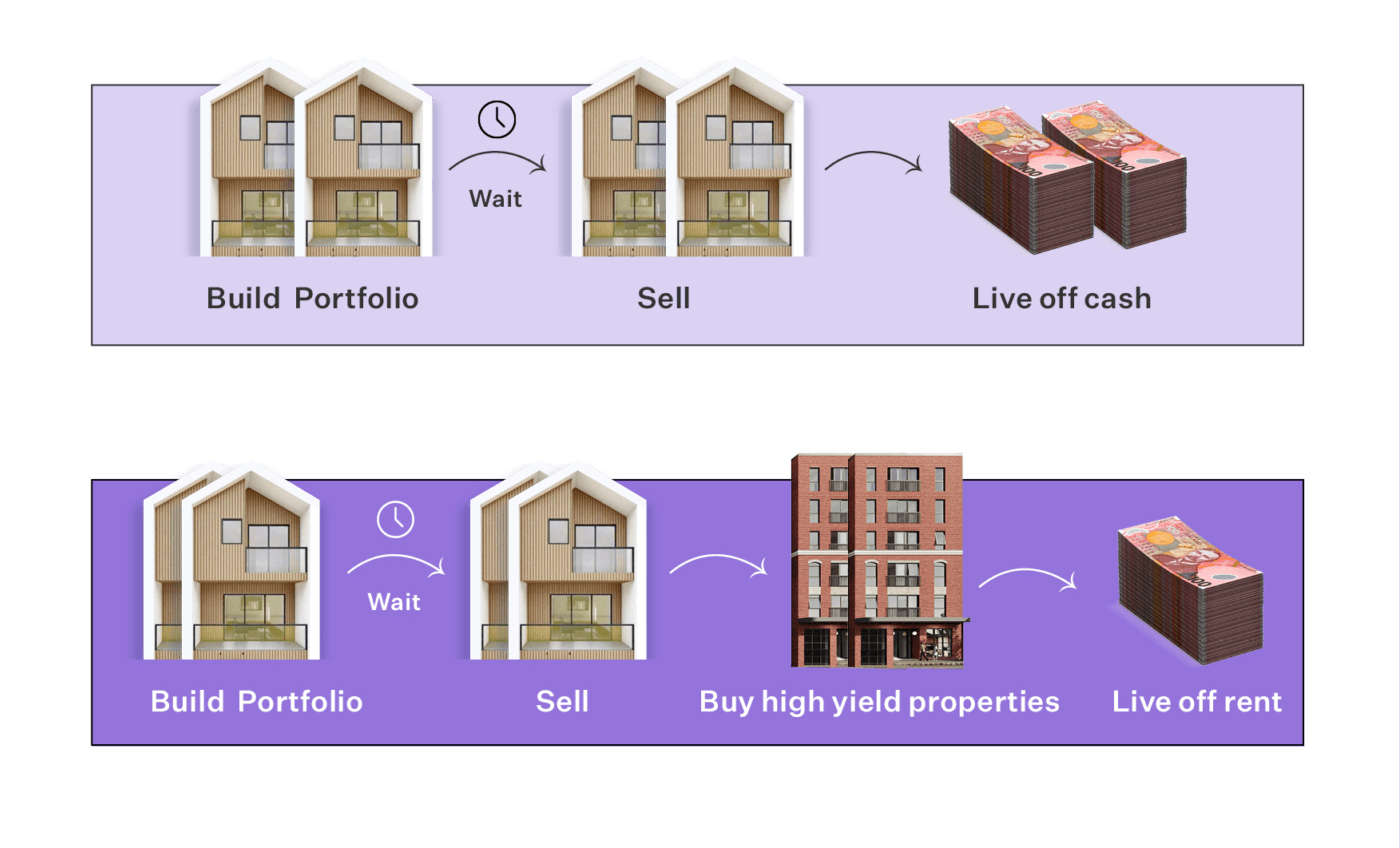
When you’re ready to transition to the 2nd phase of the Golden Goose, you don’t sell everything in a fire sale.
At this point, you might own 3-6 properties that have gradually increased in value. But these properties might not pay you much of an income. So you need to rebuild your portfolio for rental yield.
Step 1: Plan a 3–5 year transition window
You generally don’t want to sell all your properties at once in one hit.
It's not like you say: “It’s my 65th birthday, time to sell everything.” For most people, it’s a process that starts years before the retirement date and plays out gradually.
That gives you time to:
Typically, we suggest that investors plan to sell down their portfolios over a 5-year period.
In my experience, the way you transition is case-by-case. Because it depends on the market. If you planned to sell, but house prices are down, you might hold off for an extra year or two.
Step 2: Sell your growth properties
Up until now, your portfolio has focused mostly on growth properties.
These are assets that grow in value over time, even if the cash flow isn’t amazing right now.
This is where your equity is sitting.
Now, you change tack and progressively sell the properties whose main “job” was capital growth.
Step 3: Reinvest into yield properties
Now, you buy properties designed to do the opposite job: put more money in your pocket each week, even if they don’t grow as fast in value.
These are high-yield investments. Often multi-income properties like:
At this stage, many investors aim for something like:
This is the “Golden Goose moment”: you’re converting a pile of equity into an income stream. The aim is to own these properties with little to no mortgage.
Because big mortgages suck up a large part of the rental income. And at this point, you want the rent going to you (not the bank).
Step 4: Live off the rent
At this stage, most investors hand the running of their properties to a property manager. That way, they can focus on the freedom and choices they want.
(Not everyone wants to stay a landlord in retirement).
And that’s whatever that looks like to you: travel, time with your family, or just sleeping in on a Tuesday.
The amount of money you can spend on the Golden Goose strategy depends on:
But here’s an example to see how things might work out:
Let’s say you buy a dual-key apartment for $700,000. And that might bring in $800/week in rent.
Now, you don’t get to spend all of that. Because you’ll still have some ongoing property costs. That might average out at $250/week. That includes rates, insurance, property management and maintenance.
That leaves $550/week before tax.
If, say, around $200/week goes to tax, you might have roughly $350/week available to spend from that one property.
For example, if you have 2 similar properties, that might put around $700/week in your hand.
Once you’re living off the rent, the goal is to smooth everything out into a predictable “retirement pay”.
#1 – Work out what’s actually spendable
When rent hits your account, it has three jobs:
You can safely spend what’s left over after bills and tax. You can use a tool like Opes+ to estimate the cashflow.
#2 – Set up your rental account and your spending account
Your rental properties should have a separate bank account from your everyday spending account.
Otherwise, you might accidentally spend money that’s allocated for tax or other bills.
Most investors set up one bank account for their rental properties. Then they automatically transfer their spending money each week to their everyday account.
#3 – Make sure the money can legally flow to you
If you own the properties personally, rent comes straight to you.
But if the properties are held in a trust or a company, you’ll need to withdraw the money in the right way.
If this is you, it’s worth getting your accountant to confirm the setup. Different entities can have different tax treatment. And if you own the properties in a trust, you’ll need a trust resolution to distribute money to yourself.
#4 – Pay yourself a “retirement wage”
A consistent “retirement wage” stops you from overspending in good months and panicking in the bad ones. You know, when rates, insurance, maintenance (or a vacancy) pops up.
Let’s say you’ve been investing for 20 years and you’re ready to set up your Golden Goose.
But what happens if property prices fall suddenly? Does that put your Golden Goose in jeopardy?
This is a very real fear. After all, we’ve just come out of a pretty big downturn… what if you had to sell right now?
It’s also one of the reasons the slow transition matters.
But there are a few important realities:
#1 – If growth properties are cheaper, yield properties are usually cheaper too
Your properties could drop in value and sell for less than you hoped. But in that case, the yield properties you buy will often be cheaper too.
#2 – Lower house prices often increase rental yields
When house prices fall faster than rents, rental yields go up.
#3 – Staging the sell-down lowers the timing risk
If you sell over several years, you’re less exposed to one ugly 6-month period. The mistake is trying to flick everything in one go because you’ve set your retirement date in stone.
#4 – You can use different income while you ride it out
What if the market’s in a slump right when you’re meant to sell? You don’t have to force it.
Most investors find they can bridge the gap in other ways. For example, using NZ Super or KiwiSaver to tide them over for a few years.
That way, you’re not locked into selling at the worst possible time.
In New Zealand, your rental income is taxed. And the tax rates are the same as if you earned a salary. Because our tax system is progressive.
So, your first $10,000 is taxed at a lower rate than your next $10,000.
But don't forget, if you're also getting other income, like NZ Super, that’s income. And that gets taxed too. That’s why it’s worth talking to an accountant before you transition your portfolio.
For instance, if you’re a couple, splitting the rental income between the two of you could potentially mean paying less tax.
For instance, let’s say a couple both retire at 55 and they have $50,000 of rental income (and nothing else).
If all of the income is paid to one member of the couple, then they pay $7,658 in tax.
But if you split the income between the couple, they only pay $6,566 in tax.
So, splitting the income saves $1,092 in tax per year. This is just one (very simple) example. And it can get complicated.
For instance, let’s say one member of the couple is still working, while the other stops working and is supported by rental income.
In that case, paying the rental income to the person NOT working could lead to a lower tax bill. That’s because their marginal tax rate will be lower.
But then there’s even more to think about. Because you need to decide how best to own these properties. Because while one member of this couple might be working … that might not be the case in the long term.
That’s when you might use a trust, which gives you the flexibility to change who gets the income each year. But, that also opens up a new set of questions. Because then you’d also need to think about relationship property and estate planning.
I’m not mentioning all of this to confuse you. It’s to demonstrate that the tax side can get a bit complicated. That is why you need to talk to both a lawyer and an accountant before you make this transition. Because then they can consider all your personal circumstances.
The Golden Goose doesn’t usually play out like a neat switch you flick on your 65th birthday.
If everything goes to plan, start the transition around 3–5 years before you want to retire.
That way, you can rebuild your portfolio into income properties without rushing. And you can take advantage of different opportunities as the market moves.
Financial adviser for 3+ years. Helped nearly 500 Kiwis buy property.
Dennis joined the Opes Group back in 2017, and he’s now one of the longest-serving team members. He’s met with thousands of Kiwis to talk about their financial goals and has helped close to 500 of them become property investors.
This article is for your general information. It’s not financial advice. See here for details about our Financial Advice Provider Disclosure. So Opes isn’t telling you what to do with your own money.
We’ve made every effort to make sure the information is accurate. But we occasionally get the odd fact wrong. Make sure you do your own research or talk to a financial adviser before making any investment decisions.
You might like to use us or another financial adviser