
New Builds
New Builds - The ultimate guide for every property investor
Explore the essentials of investing in new builds. Our guide covers key strategies, benefits, and tips to navigate the market and maximise your investment.
Property Investment
52 min read


Author: Andrew Nicol
Founder, 20+ Years' Experience Investing In Property, Author & Host
Reviewed by: Ed McKnight
Resident Economist, with a GradDipEcon and over five years at Opes Partners, is a trusted contributor to NZ Property Investor, Informed Investor, Stuff, Business Desk, and OneRoof.
If you want to learn how to invest in property in New Zealand, you’re in the right place.
This guide is a free, step-by-step resource that walks you through the full property investment journey. That’s from choosing a strategy to buying your first (or next) investment.
It’s also a living guide. We update it regularly and keep improving it over time, including:
Think of this as your reference guide. If you get stuck or have a question later, you can come back here anytime.
Have a question or comment? Leave it in comments at the bottom of the page — we read them and use them to improve the guide.
Property investment is when you buy a property with the goal of making money, rather than living in it yourself.
Most investors make money in three ways:
1. capital growth, where the property's value increases over time, and
2. rental income, which provides ongoing cash flow while they own it.
But there are two main property investment strategies New Zealanders use. They are buy-and-hold and property flipping.
Buy-and-hold investors keep a property long term to benefit from capital growth and rental income. Sometimes, renovating the property to speed things up along the way.
Property flippers renovate a property and sell it for a profit.
It's worth considering property investment once your household income reaches around $100,000 a year. Although this depends on the property's price and your personal financial situation.
Mortgage interest on investment properties is tax deductible again from April 1, 2025 onwards.
| At a glance | |
| How returns are often made | Through capital growth (your property increases in value) and rental yield (the rent you collect). |
| Main strategies | Buy-and-hold and property flipping |
| Typical starting deposit | Around $100,000–$120,000 |
| Interest deductibility | Mortgage interest is tax deductible again from April 1, 2025 onwards (Source: IRD) |
| Bright-line test | If you sell a residential investment property within 2 years of buying it, you'll usually have to pay income tax on any profit you make. (Source: IRD) |
If you ignore all the noise, most residential investors use one of two strategies:
Your strategy matters because it determines what you buy, how you fund it, and how hands-on you need to be.
| Strategy | Buy and Hold | Buy and Flip |
| What you do | Buy a property Rent it out Hold on to it for the long term | Buy a property Renovate Sell it quickly for a profit |
| How you make money | The house rising in value (capital growth) & cashflow (sometimes). | Increase in value after you renovate. |
| Time commitment | Low – medium. | High. |
| Works for | Busy people, long-term wealth builders. | Hands-on investors who already know how to renovate. |
Neither strategy is better than the other. Both will help you achieve your property investment goals over the long term.
The question is: which is the right strategy for you? Let’s dive into them both a little more.
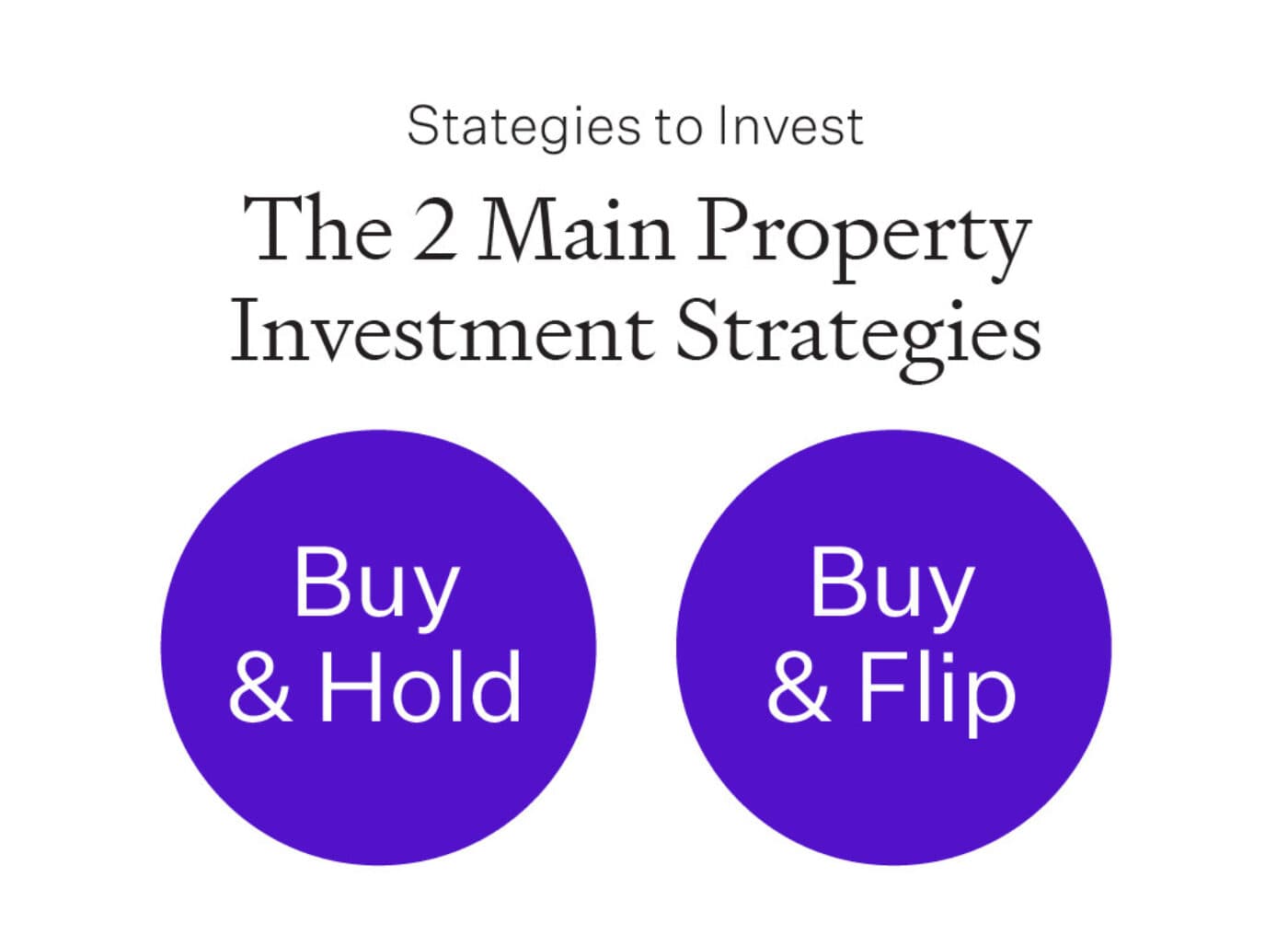
If you want something that fits around a normal job and family life, buy and hold usually wins. If you want a project and know how to renovate, then the buy and flips could be for you.
The ‘Buy and Hold’ strategy is the most common approach used by property investors in New Zealand.
Here’s why:
Put simply, this strategy makes investment accessible and realistic for everyday Kiwis who have kids, jobs and busy lives.
The ‘Buy and Hold’ is a strategy that is achievable alongside your main job. ‘Buy and Flip’ is like taking on an extra job.
There are usually 3 key steps in the Buy and Hold property investment strategy:
Rule of thumb: A buy-and-hold property should be boring in a good way. You don’t want major surprises, like an imminent roof replacement or a failing hot water cylinder.
Here are the pros and cons of the Buy and Hold strategy.
| Pros | Cons |
Less time consuming. Costs less to get started. You don’t need money for renovations. Lower risk. You’re not relying on selling quickly. | Takes longer to build equity. You don’t get the money until years in the future. |
Pro #1 – It’s the least time-consuming
Buy and Hold is close to a “set and forget” strategy.
If you buy a property that’s ready to rent (often a New Build) you can get started without doing any work.
Even if you renovate, the busy part is usually short ... then it becomes hands-off again.
How? Most investors pay a property manager to handle tenants and day-to-day issues.
Pro #2 – It’s often the most accessible
Buy and Hold is usually easier to start because you often need:
For example, many investors choosing this strategy will buy a New Build. The deposit on a New Build is 20%, compared with 30% on an existing property.
On a $600,000 property, that’s:
Flipping can also require extra cash for renovations.
Pro #3 – It’s often lower risk
Property prices move in cycles, and time can smooth out mistakes.
Buy and Hold is often lower risk because:
Flipping can still work ... it’s just less forgiving if costs blow out or the market shifts mid-project (more on this in the next section).
Con #1 – It takes longer to build equity
Many Buy and Hold property investors make the bulk of their money through the property going up in value.
While this can build a substantial amount of wealth in the long term, it takes a lot longer than what might look like a quick 3-month flip.
Con #2 – You don’t get paid immediately
You might renovate and see the property value jump by $50,000. Sure, you feel like a genius ... but that profit is often locked inside the property until you refinance or sell.
With flipping, you sell and can access cash straight away (after costs and tax considerations).
Here are my top tips to success with the Buy and Hold strategy:
#1 – Buy for long-term capital growth
Choose the right location and property type. You’re looking for an area with strong housing demand, which could lead to higher house prices.
#2 – Make sure you can hold for 10+ years
The Buy and Hold strategy works best if you can afford to keep it through the ups and downs, often for 10 years+. If you need to sell within 3 years it’s more likely the house value could have dropped.
Flipping is one of the property investment strategies Kiwis often think about first.
That’s usually because it’s the most visible. We watch TV shows like The Block, where contestants have dramatic before-and-after transformations.
But as good as the Flipping strategy looks from the comfort of our couches, we must respect and understand what it requires to be successful.
Buy and Hold can fit around your job. Buy and flip can become your job.
There are usually 5 key steps in the flipping property investment strategy:
Here are the pros and cons of the Flipping strategy.
| Pros | Cons |
Creates equity immediately. You get the money (almost) straight away. Personal satisfaction from doing up an old house. | You only get paid once (it’s one and done). Projects can go over budget. Renovations can cost more than you expect. It’s easy to make expensive mistakes. Time intensive (requires a lot of effort). Need to invest in areas near you. |
Pro #1 – You can create equity quickly
A ‘Flipping’ strategy is one of the quickest ways to create immediate capital gain (equity).
That’s because once you finish the renovation the property should be worth more than the cost of the house and the renovations (if done correctly).
One rule of thumb many flippers use is that if they spend $1 on renovations, the value of the house should go up by at least $2.
So, if you buy a house for $500,000 and spend $50,000 on the renovation. Most Flippers would want the house to rise in value by at least $100,000 (twice the renovation cost). That means they’d aim to sell the house for at least $600,000.
Pro #2 – You get the money (almost) straight away
Once you sell the property you get your rewards in cold, hard cash (after selling costs and tax). You can go out and spend that on whatever you want.
A Buy-and-Hold investor’s gains are “locked” into the property equity. Not as much fun, and not as easily accessed.
Pro #3 – You get the satisfaction of completing the project
There’s a real emotional payoff in transforming a tired property. Just remember that TV producers will sometimes edit out the stress, delays and cost overruns.
Con #1 – It’s “one and done”
Once you sell a property, the deal is over. You don’t get any ongoing benefits of the rent coming in or the property growing in value over time. Whereas Buy and Hold investors continue to earn a return from their properties.
Con #2 – Renovations often cost more than you expect
Many projects run over budget. One surprise can wipe out your profit. For instance, what happens if your builder pulls down a wall and realises there’s an electrical issue and the house needs rewiring? That could cost tens of thousands of dollars.
That could turn a profitable project into a loss-maker.
Con #3 – It’s easy to make expensive mistakes
If you’re not experienced, it’s easy to:
This is called over-capitalising; when you pay for upgrades that buyers don’t pay extra for.
Con #4 – It takes a lot of time (and it’s stressful)
Flips usually only make sense if you do a chunk of the work yourself. That means nights, weekends, decision fatigue, and a project hanging over your household.
Con #5 – It’s hard to do if the property isn’t near you
If you’re hands-on you generally need to buy close to where you live. It’s much harder (and more expensive) to manage a renovation from another city.
Here are my top tips to success with the flipping strategy:
#1 – Find a property you can add value to with your skills
Make sure you find a property that you have the skills (or ability) and budget to improve. And focus on areas that tend to increase the property’s value. Things like repainting the interior walls of a house often make a bigger difference than painting the outside.
#2 – Have a list of “must dos” vs “nice to haves”
Don’t overcapitalise on all the fancy trimmings … this is an investment property and you want to get the most bang for your buck. Focus on improvements that buyers reliably pay for. Avoid bespoke or over-personal finishes.
#3 – Be conservative with your numbers
If the deal doesn’t work on paper with conservative assumptions, it probably won’t work in real life.
Buy and Hold: You buy a property, rent it out, and keep it long term while it grows in value over time.
Buy and Flip: You buy a property that needs work, improve it (repairs, upgrades, renovation), then sell it soon after. The “flip” is the sale.
Key differences:
1. How investors make money
| Buy and Hold | Buy and Flip |
| Your gains usually build up slowly as the house goes up in value (plus rent over time). | You get paid after you renovate and then sell the property (after costs and tax). |
2. What investors tend to buy
| Buy and Hold | Buy and Flip |
| A property that’s easy to own long term (low-surprise maintenance, strong rental demand). | A property that needs love with value-add potential. A property you can improve cost-effectively. |
3. Your role
| Buy and Hold | Buy and Flip |
| Set up the property and then manage lightly (often with a property manager). | You’re running a project – planning the work, managing trades, timelines and the budget. |
Still undecided? This 30-second checklist will point you in the right direction.
Buy and Hold might work for you if you …
Buy and Flip is more likely a fit if you …
Before you invest in property you need to answer one practical question: Where will your deposit come from?
For most New Zealand investors the answer is either:
While there are other strategies, these are the ones most people use. But to understand how much deposit you need you first need to know about the Loan-to-Value Ratio restrictions.
Most investors don’t “save” their first investment deposit. They borrow it against their home
The Reserve Bank’s LVR rules state how much deposit most investors need.
Remember, a Loan-to-Value Ratio compares the size of a loan to the value of a property.
So, if a bank lends you 80% of a property’s value, you must provide the remaining 20% as a deposit.
At the time of writing, the LVRs are:
| Property type | Maximum loan | Minimum deposit |
| Owner-occupied home | 80% | 20% |
| Existing investment property | 70% | 30% |
| New Build investment property | 80% | 20% |
Let’s say you’re looking at a $600,000 property.
Now let’s flip the question around. Instead of asking, “How much is the property?” ask, “How much deposit do I have?”
If you have $100,000 deposit:
| Investment property type | Deposit required | Maximum purchase price |
| Existing property | 30% | $333k |
| New Build | 20% | $500k |
Two identical properties. Two very different deposits. That single rule can be the difference between waiting years and investing now.
But remember, these rules change.
Since this guide was originally written in 2019 the LVR restrictions have moved from 70%, to not existing, then back to 70%, then again to 60%, to 65% and now back to 70% where they sit today.
And they have moved at least 8 times since they were first introduced.
Around 9% of Kiwi adults own an investment property. From my experience most of them don’t have $100,000+ in cash lying around to invest in property.
In reality, most investors don’t save their way into multiple properties. Instead, they use the wealth locked away in their home. That’s called equity.
Equity is the difference between what a property is worth and how much debt is secured against it.
As property values rise and you pay off your mortgage, your equity grows.
Here’s how to release that equity to buy an investment property.
Equity grows in two ways:
Here’s a simple example.
Imagine you bought a home in January 2016 for $600,000 and used a 20% deposit.
Over the next few years, two things usually happen:
By 2026, the numbers might look like this:
| Property value | $950,000 |
| Mortgage | $396,000 |
| Equity | $554,000 |
So, your original $120,000 deposit didn’t just sit there … it grew to $488,000 in equity.
Now, just because you have equity doesn’t mean you can borrow all of it.
Banks will generally lend owner-occupiers up to 80% of the property’s current value.
So in this example:
| 80% of $950,000 | $760,000 |
| Existing mortgage | $396,000 |
| Potential additional lending | $364,000 |
That’s $364,000 is what’s called your usable equity. That’s how much you could potentially use as the deposit for an investment property although, of course, you still have to meet the bank’s income and lending criteria.
If you have $364,000 of usable equity, then you could potentially spend:
| Property type | Deposit % | Max purchase price |
| Existing investment | 30% | $1,213,333 |
| New Build investment | 20% | $1,820,000 |
And no, that doesn’t mean you should buy a $1.8 million property. And it doesn’t mean the bank will definitely let you borrow the money.
In practice, most investors spread this across multiple properties (perhaps one in Auckland and one in Christchurch) rather than concentrating everything in a single asset.
But the key point isn’t how much you must spend, it’s the possibility that equity creates.
If you want to figure this out quickly, you can use the equity and leverage calculator on our website
Otherwise, here’s how to do the math in your head or on your phone
| For existing properties | Deposit / 0.3 |
| For New Builds/owner occupiers | Deposit / 0.2 |
If you don’t have enough savings and you don’t own property yet … it can feel like the door to investing is closed.
It’s not, but it does mean you’ll need to think differently.
There are two common ways people bridge the gap:
If you don’t own property yet, you can lean on your parents’ equity.
In simple terms this option works exactly the same way as using your own equity … except you’re just using someone else’s.
Your parents have likely owned their home for many years and it’s grown in value. That growth may have created usable equity.
This isn’t usually a gift. Families using this option typically draw up a clear repayment agreement to protect both sides.
Remember the Loan-to-Value Ratio (LVR) rules:
Banks are allowed to do some lending outside these limits.
That means you might still be able to get a loan, even if you don’t quite meet the standard deposit requirement. You’ll simply be classified as a high LVR borrower.
For example, some first home buyers have got on the ladder using a 10% deposit; some investors purchase with less than 30%.
But there is a trade-off. Lower deposits usually mean higher interest rates and stricter lending conditions. They also mean less buffer if property values fall.
If you want to choose this option, the best advice is to talk to a mortgage adviser.
Many people assume: “I need to save another $150,000 before I can invest.”
Often, that’s not true.
The real question becomes: “How much usable equity do I already have?”
Before you choose a property, you’ve got to choose the city or region you want to invest in.
After all, a great property in the wrong market can still be a poor investment.
Remember, property investors are effectively going into business for themselves.
That business provides rental accommodation.
And like any business, you need to understand the market you’re operating in before you choose your product.
In this case:
That matters because residential property investors usually make money in two ways:
| How you make money | What it means |
| Capital growth | The property increases in value over time |
| Rental income | The tenant pays rent, which helps cover your costs |
A good investment property needs to work in both markets.
That’s why you don’t start by asking, “Is this property good?”
You start by asking: “Is this the right city or region to invest in?”
Note: This step focuses mainly on the Buy and Hold strategy, because that’s the most common approach for New Zealand property investors.
If you’re using a Buy and Flip strategy, your search will look a bit different. You’ll usually focus more on areas close to where you live, because you’ll need to manage renovations, trades, budgets and timelines.
But for Buy and Hold investors, the first job is not to find a property. It’s to find the market you want to be in.
Before you look for a specific property, choose the market you want to invest in. A great property in the wrong city can still be a poor investment.
Property markets are local.
A house in Gisborne is not a substitute for a house in Auckland if someone needs to live in Auckland for work, family or lifestyle.
That means each city has its own property market. Auckland prices can rise while Wellington stays flat. Then a few years later, the opposite can happen.
So you can’t just ask, “Is New Zealand property going up or down?”
You need to ask, “What’s happening in this city?”
For example, a tidy 3-bedroom house for $400k might sound like a bargain. But if it’s in a small town with low population growth, limited jobs and weak long-term demand, it may not be a strong investment.
That doesn’t mean small towns are bad places to live. It just means they may not have the fundamentals investors usually look for.
Here are 5 key factors to consider when choosing a region to invest in.
Property markets move in cycles.
Sometimes prices in a region run hot. Other times they fall behind the rest of the country.
One way to analyse a region is to compare:
It’s not a crystal ball.
But it can help you see whether a region looks expensive or cheap compared with its own history.
| If a region looks undervalued | If a region looks overvalued |
| It may have more room for future house price growth over the medium term | House prices may not go up as fast in the medium term |
| There may be better buying opportunities | There may be buying opportunities elsewhere |
If you’re looking for up-to-date property market data, you can find it using Area Analyser. Here’s a list of some of the regions we cover:
When we say a region is overvalued or undervalued, we mean compared with where its house prices usually sit over the long term.
If prices are lower than where we’d expect them to be, that can suggest a buying opportunity.
But that’s only the first layer.
A region might be undervalued, but some parts of that region may be much better opportunities than others.
That’s because many New Zealand regions are large.
The Waikato, for example, stretches all the way from the Coromandel Peninsula down to Taupō.
Canterbury goes all the way from Kaikōura to Timaru. It would take you over 4 hours to drive from one part of the region to the other.
Each area can behave differently.
One council area may have stronger population growth. Another may have better rental yields. Another may be more affordable for your budget.
So, don’t stop at “Canterbury looks good” or “Waikato looks undervalued”.
Ask: What part of the region gives me the best mix of growth potential, rental demand and affordability?
That’s why the next step is to break the region down into smaller areas.
For example, within Canterbury, you might compare:
Bottom line is, a region can look attractive overall, but one council area may suit your budget and strategy better than another.
Population growth matters because more people usually means more demand for housing.
That can support both:
If more people want to live in a city, they need somewhere to live.
That can be good for investors who already own property there.
But again, population growth is not always spread evenly.
One council area might be building new subdivisions, attracting families and adding jobs.
Another might have an ageing population and fewer new residents.
Take Canterbury as an example.
According to Stats NZ population projections, Selwyn District (within Canterbury) is expected to grow by 47% between 2023 and 2048. This makes it the fastest-growing district in the region.
Kaikōura District, on the other hand, is projected to barely grow.
They’re in the same region. But they may have very different investment prospects.
| Good sign | Bad sign |
| Population is projected to grow | Population is flat or falling |
| Families and workers are moving in | Young people are leaving |
| New houses, schools and infrastructure are being built | Services are closing or shrinking |
| Demand for rentals is likely to stay strong | Tenant demand may be limited |
Population growth is good.
But population growth alone doesn’t push house prices up.
People also need enough income to pay higher prices and higher rents.
That’s why you also need to look at the economic strength of the area you want to invest in.
In plain English:
A city with strong employment and rising incomes is more likely to support higher rents and house prices over time.
A city with weak employment and low income growth may struggle, even if property looks cheap.
You should also consider if you’re planning to invest in an area with only one major employer or industry.
For example, when Silver Fern Farms closed its Fairton meat works in 2017, about 370 workers lost their jobs.
And near Ohakune, Winstone Pulp International shut two local mills in 2024, with about 230 jobs lost.
All of these business closures could have a major impact on the housing market.
So don’t just ask: “Are more people moving to the city I’m interested in?”
Ask: “Can those people afford higher prices and rents?”
There’s an old saying in property investment: “You can’t use capital gains to pay the mortgage.”
That’s true.
Even if your property goes up in value over 10 years, you still need to pay the bills along the way.
That’s why rental yield matters.
Rental yield compares the rent you receive with the price of the property.
In simple terms:
For Buy and Hold investors, this matters because you need to hold the property long enough to get the long-term gains.
If the property is too expensive to hold, you may be forced to sell before the strategy has had time to work.
What’s a good rental yield vs a bad one depends on where you live.
Take Southland, where the median gross yield is around 5.8%. Property values are generally lower, so yields tend to be higher.
The middle 50% of yields in Southland sit roughly between 5.5% and 6.5%.
Compare that to Auckland, where higher property values typically result in lower yields. In Auckland, the middle 50% of yields range from 3.2% to 4.6%.
This is why you should ignore blanket statements like “any property with a gross yield under 5% is rubbish”. That might be true in one part of the country, but could be completely unrealistic in another.
The key is to match the city to your budget and risk appetite.
Capital growth builds wealth. Rental income helps you stay in the game long enough to get it
Here’s a simple way to compare cities.
| Factor | What you're checking | Why it matters |
| Overvalued or undervalued | Where prices sit compared with history | Helps identify where opportunities may exist |
| Population growth | Whether more people are moving in | More people usually means more housing demand |
| Economic strength | Whether people have jobs and rising incomes | Supports rents and house prices |
| Rental yields | How much the rent covers the costs | Helps you hold the property long term |
No city will score perfectly on every factor. That’s normal.
You’re looking for the best balance based on your strategy, budget and goals.
Once you’ve chosen a city or region, the next step is to dig deeper.
That usually means looking at suburbs.
Within the same city, one suburb may have stronger capital growth, while another has a higher rental yield.
But don’t jump ahead too quickly.
The main goal in Step 3 is to choose the market you want to operate in.
Once you’ve done that, you can start looking for the right suburb, then the right property.
The order matters:
That way, you’re not just buying a house.
You’re buying into a market that supports your long-term investment goals.
Before you jump onto Trade Me to go shopping for an investment property, you need to know what you’re actually looking for.
Investment properties can look similar on the outside. But they can perform very differently.
A townhouse, a house, an apartment and a piece of land can all be “investment properties”.
But they usually suit different investors, budgets and strategies.
So in this step, we’ll break down properties in 3 ways:
| How to categorise properties | What it means |
| Property type | House, townhouse, apartment or land |
| Growth vs yield | Whether the property is more likely to grow in value or provide stronger rent |
| Age | New Build vs existing property |
The first way to categorise investment properties is by type. This means asking: What kind of property are you actually buying?
| Standalone house | A house that is not attached to another property |
| Townhouse | An attached home, often part of a development |
| Apartment | A home inside a larger building |
| Land | An empty section with no house on it |
Each property type has different strengths, weaknesses and risks.
A standalone house is a home that is not attached to another property.
It usually sits on its own section and often has more land than other property types.
This is the classic Kiwi home.
| Pros | Cons |
| More ways to add value | More expensive to buy |
| Often easier to renovate | Often lower rental yields |
| Can be easier to sell | Less diversification if your money is tied up in one property |
| May have stronger capital growth | Can be more expensive to maintain |
Standalone homes are easier to renovate. You might be able to add bedrooms, build a sleepout, or renovate the bathroom and kitchen.
That makes them a better fit for investors using an active strategy, like renovating or adding value.
They can also be easier to sell, because many owner-occupiers prefer standalone houses. If more buyers want that type of property, you may have a larger resale market.
That said, standalone houses are usually more expensive and tend to have lower yields.
That doesn’t make them bad investments. It just means they are often more focused on long-term capital growth than short-term cashflow.
| Standalone houses may suit investors who | They may not suit investors who |
want to renovate or add value have a larger deposit want more control over the property are focused on long-term capital growth can afford weaker cashflow while they hold the property | need strong rental income have a smaller deposit want a hands-off investment want to buy multiple properties sooner |
Townhouses are usually attached homes.
They often share one or two walls with neighbouring properties and may be part of a larger development.
They commonly have:
Townhouses are common in New Zealand’s main cities and are often bought by investors.
| Pros | Cons |
More affordable than standalone houses Often available as New Builds Can have a good mix of growth and yield Often in central suburbs Popular with tenants and first-home buyers | Less land Less control over exterior changes May have Residents' Association fees Harder to renovate extensively Similar properties may compete for tenants |
Townhouses can be a good middle ground – cheaper than standalone houses. But they often grow in value faster than apartments.
They are also commonly built as New Builds, which can make them more accessible for investors using a Buy and Hold strategy.
The downside is that you have less control owning a townhouse.
A Residents' Association (the group that manages shared areas and sets rules for the development) may tell you what you can and can’t do to the outside of your property.
There is often less land, so it’s harder to add value through landscaping, extensions or minor dwellings.
New townhouse developments can also create tenant competition if many similar properties are completed at the same time.
That’s why location and rental demand matter.
| Townhouses may suit investors who: | They may not suit investors who: |
want a passive Buy and Hold property want a New Build have a moderate deposit want a balance between growth and yield don’t want to renovate | want to do major renovations need very high rental yield only want standalone houses don’t like residents’ association rules |
An apartment is a home inside a larger building.
You usually own the inside of your unit, while sharing common areas with other owners.
That can include lifts, lobbies, gyms and pools.
Most apartments have a body corporate. This is a group that manages the shared parts of the building and charges owners fees for maintenance and upkeep.
Common apartment types can be:
Dual-key apartment: Two separate rentable spaces under one legal title.
| Pros | Cons |
Lower purchase price Often higher rental yields Lower maintenance Often in central locations | Usually slower capital growth Body corporate fees Less control over the building Some banks may require a larger deposit Smaller resale market for some apartments |
Apartments can be more affordable. So, they may help some investors get into the market sooner.
They can also produce higher rental yields because the purchase price is lower, while rent can still be relatively strong.
That can make apartments attractive for investors who care more about income than long-term capital growth.
The downside is, that apartments have historically grown in value more slowly than houses and townhouses.
They can also have high body corporate fees, especially if the building has lifts, gyms, pools or other expensive shared services.
Some apartments can also be harder to finance. Banks may ask for a larger deposit if the apartment is small, unusual or has a limited buyer market.
| Apartments may suit investors who: | They may not suit investors who: |
have a smaller deposit want higher rental yield are close to retirement want more income from their portfolio want a low-maintenance property | want strong capital growth want to renovate or add value dislike body corporate fees want a large resale market |
Land banking means buying land and holding it for several years, hoping it becomes more valuable in the future.
Some investors buy land and hold it. Others buy land to develop.
| Pros | Cons |
Can grow in value quickly in a rising market No tenants to manage Little day-to-day maintenance | No rent while you hold it Can be risky if the market doesn't move Building requires more capital and risk |
The cool thing about buying land is it can increase in value quickly when developers want it or if it gets rezoned.
If house prices rise faster than building costs, developers may be willing to pay more for land because development becomes more profitable.
Land also gives you the option to build and add value.
The downside is that land usually has no income.
So, you still pay the mortgage, rates and other holding costs, but there is no tenant paying rent.
This can make land banking hard for everyday investors.
It can also be risky. If the land doesn’t increase in value quickly, you may be left paying costs for years without any cashflow.
| Land may suit investors who: | It may not suit investors who: |
have strong cashflow from other sources understand development can handle higher risk have enough capital to build later | need rental income have limited surplus income want a passive investment are buying their first investment property |
There is no "best" property type. The right property is the one that fits your strategy, budget and goals.
The next way to compare properties is by growth and yield.
Unfortunately, in most cases, there is a trade-off between growth and yield.
Higher-growth properties often have lower rental income, while higher-yield properties often grow in value more slowly.
Most properties lean one way or the other.
| Property type | Usually stronger at |
| Standalone house | Growth |
| Townhouse | Growth |
| Apartment | Yield |
| Dual-key / multi income property | Yield |
| Land | Growth |
Growth properties are usually bought because they are expected to increase in value.
They often appeal to owner-occupiers, which can help push up resale prices.
The trade-off is cashflow.
Growth properties often have lower rental yields, so you may need to contribute more money each week to hold them.
Yield properties are bought because they produce stronger rent.
These properties may produce better cashflow, but they often have a smaller market when you sell.
That’s because the next buyer is more likely to be another investor, not an owner-occupier.
| Factor | Growth property | Yield property |
| Main goal | Increase in value | Rental income |
| Typical buyer | Owner-occupier or investor | Mainly investor |
| Cashflow | Often weaker | Often stronger |
| Resale market | Usually broader | Often narrower |
| Best for | Long-term wealth building | Income or cashflow support |
Townhouses are a good option for passive buy-and-hold investors. They are very popular among the investors we work with here at Opes Partners.
In fact, 76% of the properties investors bought through us between January – June 2022 were townhouses.
So, let’s go through the benefits of townhouses and who they tend to be the right fit for.
We’ll also talk about the other side of this, which is the drawbacks of townhouses.
Capital growth builds wealth. Rental income helps you hold the property long enough to get it.
The final way to categorise properties is by age: Is it a New Build or are you buying an existing property?
In simple terms:
| Property age | What it means |
| New Build | Brand new property, usually bought from a developer |
| Existing property | A property that has already been lived in or owned before |
Both can be good investments, but they suit different strategies.
So, neither option is automatically better.
The better question is: “Which one suits your strategy?”
| Factor | New Build | Existing property |
| Best suited to | Buy and hold investors | Renovations-focused investors |
| Deposit | Often lower | Often higher |
| Maintenance | Lower | Higher |
| Ability to add value | Limited | Higher |
| Cashflow | More predictable | Can be better after renovation |
| Risk | Developer/build risk | Renovation/maintenance risk |
| Time required | Lower | Higher |
A New Build is a brand new property. This means you are usually the first owner.
You might buy it:
New Builds are often townhouses, but they can also be standalone houses or apartments.
| Pros | Cons |
| Often lower deposit requirement | Limited ways to add value |
| Lower maintenance | May not be ready immediately |
| More predictable cashflow | Often weaker cashflow than a renovated existing property |
| Often attractive to tenants | You rely on the developer delivering the property |
New Builds are often easier for investors to buy.
You often only need a 20% deposit to buy a New Build, compared to a 30% deposit for an existing property. That’s according to the Reserve Bank’s LVR rules.
They can also have lower maintenance because everything is new. That means fewer unexpected costs, like replacing an old roof, hot water cylinder or major chattels.
New Builds can also attract good tenants because they are warm, dry and modern.
The downside is, New Builds don’t usually give you many ways to add value.
The kitchen is already new. The landscaping is usually done.
That means you generally can’t manufacture quick equity through a renovation.
New Builds are usually a better fit for investors who want to buy and hold, not investors who want to actively renovate.
| New Builds may suit investors who: | They may not suit investors who: |
want a passive investment have a smaller deposit want lower maintenance want more predictable cashflow don’t want to renovate | want to add value quickly want to renovate want the cheapest property on the market need immediate high cashflow |
Existing properties are homes that have already been owned or lived in.
Most properties listed on Trade Me or realestate.co.nz are existing properties.
| Pros | Cons |
More way to add value Can renovate to increase rent Available immediately Can suit active investors May create quick equity | Often need a higher deposit Higher maintenance Less predictable costs May have weaker cashflow before renovation Can take more time, skill and money |
Existing properties give you more opportunity to add value.
You might repaint, replace the carpet, renovate the bathroom or add bedrooms.
All these things can increase both the value of the property and the rent you can charge.
This is why existing properties often suit investors using renovation, flipping or BRRRR-style strategies.
The downside is that existing properties can cost more to maintain.
Older homes are more likely to need repairs. Chattels wear out. Roofs get older. Plumbing, wiring and insulation may need attention.
For investors, they also require a 30% deposit, compared to a 20% deposit for New Builds.
That makes them harder for some first-time investors to buy.
| Existing properties may suit investors who: | They may not suit investors who: |
want to renovate have extra cash for improvements want to manufacture equity are comfortable managing trades want stronger cashflow after renovation | want a passive investment have limited cash after settlement don’t want maintenance surprises don’t have time to manage renovations |
Once you know the type of property you want, you can start looking.
There are 3 main places to find investment properties.
| Where to look | Best for |
| Property websites | DIY investors looking for existing properties |
| Property investment companies | Investors who want New Builds |
| Developers | Investors who want to buy a New Build directly |
Many investors start with websites like:
These websites give you a wide range of properties. But that is also the problem.
There are a lot of listings, and most are not designed to be investment properties.
| Websites are usually a better fit if you: | They may be harder if you: |
want to buy an existing property are comfortable doing your own research know how to run the numbers want to renovate, flip or add value | want a New Build want a done-for-you process don’t know how to analyse a property want someone to help you choose |
Rather than finding a property yourself, a property investment company helps you build a strategy and recommends properties that fit it.
This is what we do at Opes Partners.
For example, our financial advisers can help you understand your goals, help you build an investment strategy, and recommend properties that fit your plan.
They’ll also run the numbers for you and hold your hand throughout the buying process.
Some people will love this hands-on approach, others … not so much.
| They may be a good fit if you: | They may not be the right fit if you: |
want a hands-off investment want help choosing a property want a New Build don’t want to renovate want advice before you buy | want to flip properties want to renovate want to buy in a very specific small town only want existing properties |
You can also buy a New Build directly from a developer.
This can work well if you already know where you want to invest and what type of property you're looking for.
The benefit being you go straight to the source.
The downside is that the developer has their own product to sell. So, they usually won’t compare their property with every other option in the market.
If you go direct to a developer, it is still worth getting independent financial advice before you buy.
| It may be a good fit if... | It may not be a good fit if... |
You already know what type of property you want You want a New Build You're comfortable analysing property deals yourself You have a specific development or developer in mind You understand the risks and numbers involved | You need help choosing a strategy You want someone to compare multiple options for you You want independent advice before deciding You want someone to negotiate or source properties on your behalf You're a first-time investor who isn't sure what to buy |
Once you find a property you like, don’t buy it just because it looks pretty.
Run the numbers first.
At minimum, you’ll want to understand:
| Number to check | Why it matters |
| Purchase price | What you are paying |
| Deposit required | How much money you need to buy it |
| Rent | How much income it produces |
| Gross yield | How rent compares with price |
| Mortgage costs | Your largest regular expense |
| Rates and insurance | Ongoing holding costs |
| Maintenance | Expected repairs and upkeep |
| Body Corporate and Residents' Association fees | Extra costs for apartments and townhouses |
| Tax | Whether you need to pay extra tax |
| Cashflow | How much you pay or receive each week |
If you’re working with a property adviser or accountant, they may do this for you.
If not, use a spreadsheet or calculator so you can compare properties properly. For instance, you might use Opes+, a free software that helps you analyse your property’s potential returns.
A property can look good online and still be a poor investment once you run the numbers.
By the end of Step 4, you should know what type of property suits your strategy.
Maybe it’s a standalone house, if you want to renovate and chase growth
It could be a townhouse if you want a more hands-off investment with less maintenance involved.
Either way, the order matters:
That way, you’re not just scrolling listings and hoping something stands out.
You’re shopping with a plan.
Most property investors need 5 to 6 key professionals around them.
Buying an investment property is one of the biggest financial decisions you’ll make. Getting it wrong can be expensive.
New Zealand has a strong DIY culture. We like to figure things out ourselves.
But property investing is one area where getting expert advice can save you time, stress and costly mistakes.
In this step we’ll walk through the main professionals who can help you buy, own and manage an investment property.
| Professional | Typical cost to you | What they help with |
| Mortgage advisers | Usually free | Getting your lending sorted |
| Insurance adviser | Usually free | Protecting your income, property and family |
| Solicitor | $2,500-$3,500+ | Checking the legal documents |
| Property accountant | $500 - $2,000+ per year | Tax and ownership structure |
| Property manager | 8-9% of rent + fees | Managing the tenant and property |
| Property adviser | usually free (but ask) | Finding the right investment property |
You don’t need to know everything yourself, but you do need the right people around you.
Cost to you: Usually free
Help with: Getting your lending sorted
A mortgage adviser (often called mortgage brokers) helps you get lending from the bank.
They understand bank rules and lending policies and know which banks are more likely to approve different types of borrowers and properties.
They can also help you structure your loans in a way that suits your goals.
A mortgage adviser can help you:
This is very valuable because banks treat investors differently.
One bank may decline your application; another may say ‘yes’.
A good mortgage adviser can help you avoid wasting time with banks that are unlikely to approve you.
They can also help you avoid setting up your loans in a way that holds you back later.
For example, if you already have your own home loan you may not want to repay your investment property loan in the same way.
That’s because the way your loans are structured can affect:
| A mortgage adviser may be a good fit if you: | They may not be needed if you: |
| want help getting finance | already have a strong relationship with your bank (e.g. you have a private banker) |
| want to compare lenders | understand lending rules yourself |
| are buying your first investment property | have simple lending needs |
| want help structuring your loans | are confident arranging finance directly |
| want to grow a property portfolio over time | don’t want to use a broker |
Mortgage advisers don’t usually charge you a fee. Instead, they get paid a commission from the bank when they help you get a home loan.
But some mortgage advisers do charge fees; and many will charge a fee if you get a loan from a non-bank lender. That’s because some non-bank lenders don’t pay commissions.
So always ask how your mortgage advisers gets paid before using them.
Cost to you: Usually free
Helps with: Protecting your income, property and family
An insurance adviser helps you choose the right insurance. But this is not just about getting insurance for the property.
Property investors often need other types of insurance like:
An insurance adviser can help you work out what the right level of cover is for you.
To do this, they’ll ask you about your situation. For example, do you have kids? How old are you? What’s your job?
Then they’ll compare insurance policies and help translate some of the fine print.
This matters because not everyone needs the same amount of insurance, and not all insurance policies are the same.
Two policies can look similar, but the fine print may be different. That can be the difference between getting a claim paid out … and not.
An insurance adviser can also help at claim time, which can take some of the stress away.
| An insurance adviser may be a good fit if you: | They may not be needed if you: |
| want help choosing cover | already understand insurance policies |
| have a mortgage or dependants | have simple insurance needs |
| want someone to compare insurers | are confident reading policy documents |
| want help at claim time | already have trusted cover in place |
| don’t know what level of cover you need | don’t want personal insurance advice |
Like mortgage advisers, insurance advisers are usually paid by the insurance company when you take out a policy.
That means many advisers don’t charge you directly. But, again, ask how they are paid before you use them.
Cost to you: $2,500–$3,500 (as an estimate)
Helps with: Checking the legal documents
A solicitor helps you with the legal side of buying a property. And like it or not, your solicitor will be one of the most important people on your team. You can’t buy a property in New Zealand without one.
A solicitor reviews the legal documents involved in the purchase and explains any risks before you commit. This may include:
| Document | Detail |
| Sale and purchase agreement | Contract used to buy the property |
| LIM report | A council report containing all the information the council holds about the property |
| Title | Shows who legally owns the property and any rights, restrictions or obligations attached to it |
| Loan documents | The legal documents relating to your mortgage |
| Cody corporate documents | Rules, fees and information about shared ownership arrangements (common with apartments) |
| Developer contracts | Agreements used when buying a New Build from a developer |
| Special clauses | Additional conditions that may be added to the contract |
| Settlement documents | Paperwork used to transfer ownership of the property to you |
This matters because property contracts can include clauses that are not in your favour. And they are usually hidden behind jargon that you don’t understand.
For example, a New Build contract may include a sunset clause. A sunset clause gives a party the right to cancel the contract if the property is not completed by a certain date.
That clause can be written in different ways.
Sometimes it protects the buyer; sometimes it protects the developer.
Your solicitor’s job is to check this before you sign.
Solicitors can also pick up issues with the title, the LIM, or the way the property has been altered.
For example, if part of a cross-lease property has been built but is not shown correctly on the plan, that can create legal and lending issues.
In plain English: your solicitor helps make sure you understand what you are buying before you are locked in.
Solicitors often charge you in the region of $2,500 - $3,500, but the exact cost depends on the lawyer and the complexity of the purchase. So, it’s hard to give you an exact figure.
Ask for an estimate upfront so you can include this in your buying costs.
Cost to you: Between $500 - $2000 a year
Helps with: Getting the tax and ownership structure right
A property accountant helps with the tax and accounting side of your investment.
This matters because property investing is not just about buying a house.
It’s also about owning an asset, tracking income and expenses, and paying the correct amount of tax.
A property accountant can help you:
A property accountant helps you avoid owning the property in the wrong structure.
For example, some investors buy in their own name, others use a company or trust.
There is no single right answer.
The right structure depends on your income, goals, family situation, lending and tax position.
This is why it’s worth getting advice before you buy, not after.
| A property accountant may be a good fit if you: | They may not be needed if you: |
| own or plan to buy an investment property | have very simple tax needs and already have an accountant |
| want help with tax | are confident doing your own property accounting |
| are unsure what ownership structure to use | understand the tax rules yourself |
| own multiple properties | don’t need personalised tax advice |
| want to avoid mistakes with IRD |
Property accountants usually charge a direct fee. But the cost depends on the accountant, the number of properties you own and the complexity of your situation.
At Opes Accounting, we charge a flat fee of $1350 + GST for your first property in an entity. Then it’s $200 + GST for every extra property. Property accountants usually charge a direct fee. But the cost depends on the accountant, the number of properties you own and the complexity of your situation.
At Opes Accounting, we charge a flat fee of $1350 + GST for your first property in an entity. Then it’s $200 + GST for every extra property.
Cost to you: 8-9% management fee + GST. Additional fees often apply for finding a tenant, inspections, advertising and other services.
Helps with: Managing the tenant and property
A property manager manages the rental property for you.
They deal with the tenant, rent, maintenance and inspections.
This can save you time and reduce stress.
A property manager can:
This is important because being a landlord is not just collecting rent.
You need to:
That can take time.
It can also be stressful if a tenant stops paying rent, damages the property or disputes something.
A good property manager deals with these issues on your behalf.
They can also help protect your insurance. Many insurance companies require you to inspect your property every 3 months. If you don’t (or it’s not recorded) you might not get the insurance payout you’re expecting.
| A property manager may be a good fit if you: | They may not be needed if you: |
| want a hands-off investment | want to self-manage |
| live far away from the property | understand tenancy law |
| don’t want to deal with tenants | have time to manage the property properly |
| want help with inspections and rent arrears | are comfortable handling disputes |
| plan to grow a portfolio | want to save the management fee |
Property managers usually charge a percentage of the rent – somewhere between 8%-9% + GST of the rent each week.
They may also charge extra fees for finding a tenant, inspections or advertising.
For example, some companies charge one week’s rent for a tenant sourcing fee. Some charge $55 per inspection.
It depends on the company, so ask for a full fee schedule before choosing a property manager.
Cost to you: Usually free (but double-check)
Helps with: Finding the right investment property for you
A property adviser helps you build a plan and find an investment property that fits your strategy.
This is what we do at Opes Partners.
This is different from simply finding a house you like.
A good investment property should match your budget with your overall goals.
A property adviser may help you:
These terms are sometimes used differently, but here is the simple version.
| Type | What they usually do |
| Property finder | Finds you a property you’ve asked them for |
| Property adviser | Helps you decide what to buy and why |
If you don’t use a property adviser, you need to find and assess the property yourself.
That can work if you know what you’re doing.
But the risk is buying a property that looks good but does not fit your long-term plan.
For example, you might buy a high-growth property when you actually needed cashflow.
Or you might buy a high-yield property when your goal was long-term wealth building.
A property adviser helps connect the property to the strategy.
| They may be a good fit if you: | They may not be needed if you: |
| want help choosing a property | already have a clear strategy |
| want a more hands-off process | want to find deals yourself |
| want someone to run the numbers | are focused on renovations or flipping |
| are buying your first investment property | already have a trusted team |
| want a New Build or passive investment | want to buy in a very specific area they don’t cover |
Most of the time your property adviser is paid by the developer or property seller if you buy a property they recommend.
But that doesn’t mean all property advisers are free.
Our advice is always ask:
The thing is, you don’t need every professional on day one.
But most investors will use several of them during the buying process.
| Stage | Who usually helps |
| Before you buy | Property adviser, mortgage adviser |
| Finding the property | Property adviser |
| Checking the deal | Solicitor, accountant |
| Getting finance | Mortgage adviser |
| Protecting yourself | Insurance adviser |
| After settlement | Property manager, accountant |
The right team helps you avoid expensive mistakes before they happen.
Now you know who you need on your property investment team.
That might include:
You don’t need to become an expert in lending, tax, law, insurance and tenancy rules.
But you do need to know when to ask for help.
Before you buy an investment property you need to know three things:
| What you need to work out | Why it matters |
| How will you fund the property? | You often need to get a mortgage before you can buy |
| Does the property give you a good return? | There’s no point investing in a property that doesn’t give you a return you’re happy with |
| Can you afford to hold it long term? | You can’t get the long-term benefits from property if you don’t hold it over the long-term |
A property can look good online and still be a poor investment if the numbers don’t work.
Most investors use a mortgage to buy an investment property.
But not all mortgages work the same way.
The two main options are:
| Mortgage type | What it means |
| Principal and interest | You pay the interest and also slowly pay down the loan |
| Interest-only | You only pay the interest. The loan does not go down |
A principal and interest mortgage is the type of loan many people use for their own home.
Each repayment includes:
So over time, the loan gets smaller.
An interest-only mortgage means you only pay the interest.
You don’t pay down the loan during the interest-only period.
So if you borrow $500,000, the loan stays at $500,000 unless you make extra repayments or change the loan later.
Many property investors use interest-only loans because they can improve cashflow.
An interest-only loan can make that weekly cost more manageable. That can mean you can afford to hold onto it for longer.
But there are a few catches:
You also need to know that interest-only loans typically last 5 years. After that you automatically switch to a principal and interest loan, so your repayments can jump.
That’s why many property investors will keep applying for interest-only periods.
In plain English: interest-only loans can help you hold the property, but they don’t make the debt disappear.
| Interest-only may suit investors who: | Principal and interest may suit investors who: |
still have a mortgage on their own home want to prioritise paying off personal debt first want better cashflow are renovating and need to keep costs down while the property is empty | have already paid off their own home are closer to retirement want to reduce debt over time are less focused on buying more properties want lower debt later in life |
Interest-only lending can improve cashflow, but it also means you are not reducing the loan. Talk to your mortgage adviser before choosing.
Once your mortgage application is underway you still need a way to compare properties.
Let’s say you’re looking at three similar houses.
They might all be:
So how do you choose between them?
This is where investors use numbers.
There are 4 common metrics you’ll hear investors talk about. We’ll explain how these are calculated below, but here’s the summary:
| Metric | Best for | Pros | Cons |
| Gross yield | A quick first check | Easy to calculate and commonly used | Doesn’t include expenses, mortgage costs, vacancy or capital growth |
| Net yield | Comparing properties with different running costs | Includes operating expenses | Doesn’t include mortgage costs or capital growth |
| Cashflow | Working out if the property makes or costs you money | Shows whether the property may cost or make money each year | Doesn’t include capital growth |
| Return on Investment | Choosing between serious options | Gives the fullest picture of the investment | Relies on assumptions about the future |
Let’s use one simple example all the way through.
Say you’re looking at a property that costs $500,000 and rents for $500 a week.
That means it could earn $26,000 a year in rent. Here’s what the different metrics look at:
Gross yield is usually the first number investors look at.
It compares the annual rent with the purchase price.
In simple terms: Gross yield = annual rent ÷ purchase price
Using our example: Gross yield = $26,000 ÷ $500,000 = 5.2%
Gross yield is useful because it’s quick and easy to calculate.
The downside is that it doesn’t include any of the property’s costs. And it doesn’t consider that you might not have a tenant for all 52 weeks of the year.
So while it’s a useful first check, it shouldn’t be the only number you rely on.
Net yield takes things a step further.
Instead of just looking at rent, it also includes operating costs like:
But it ignores your mortgage. That’s because everyone’s mortgage is different. We pay different interest rates, and some investors take out bigger mortgages than others.
So the net yield still just looks at the property.
In simple terms: Net yield = (annual rent - operating expenses) ÷ purchase price
Let’s say this property has $10,565 of operating expenses each year.
That means: Net yield = ($26,000 − $10,565) ÷ $500,000 = 3.1%
Net yield gives you a more realistic picture because it shows how much the expenses are eating into the property’s income.
Cashflow goes one step further again.
It includes operating expenses and mortgage costs.
This is often the number investors care about most because it tells you whether the property is likely to cost you money or make you money each year.
Let’s say this property has $14,000 of mortgage interest costs each year.
That means: Cashflow = $26,000 − $10,565 − $14,000 = $1,435
In this example, the property is cashflow positive.
That means the rent covers the expenses and leaves a little money left over.
But a cashflow-negative property is not automatically a bad investment.
A property might cost you $150 a week to hold, but if it increases in value by more than that you can still make money.
Which brings us to the final metric.
Gross yield, net yield and cashflow are all useful.
But they only tell part of the story.
Return on investment, or ROI, looks at the bigger picture.
In plain English: ROI works out how many dollars you may get back for every dollar you put in.
That’s important because property investors don’t just make money from rent.
They can also make money from:
This is why ROI is often the most useful metric when comparing two properties.
A good ROI calculation brings all the major parts of the investment together.
For example, one property might have stronger cashflow.
Another might have stronger growth potential.
Looking at cashflow alone won’t tell you which investment is better.
ROI helps you compare the total expected return against the money you actually need to put in.
But the catch is ROI is only as good as the assumptions behind it.
If you assume a property will grow by 6% a year and it only grows by 2%, the result will look very different.
The same is true if:
That’s why it’s important to test different scenarios rather than relying on one optimistic forecast.
But the Return on Investment takes more number crunching. You can analyse investment properties for free using Opes+.
This is a free property-investing app we built to help investors run the numbers on their properties.
Gross yield, net yield and cash yield help you understand different parts of an investment. Return on Investment brings them together and helps you compare the overall opportunity.
Once you know the return, you still need to know whether you can afford to hold the property week-to-week.
This is where you need to understand cashflow.
We already introduced this above, but it’s important to look at it again.
In plain English:
Cashflow = money coming in – money going out
For an investment property, the money coming in is usually rent.
The money going out includes things like mortgage interest, rates, insurance, maintenance, property management and tax.
| Cost | What it means |
| Mortgage interest | The cost of borrowing money from the bank |
| Property management | Paying someone to manage the tenant and property |
| Insurance | Cover for the property and landlord risks |
| Maintenance | Repars and upkeep |
| Rates | Council charges for local services |
| Accounting | Tax returns and advice |
| Body corporate/Residents' fees | Shared costs for apartments and some townhouses |
| Tax | Any tax payable on the property |
Let’s say you buy a $500,000 property that rents for $500 a week.
That gives you $26,000 a year in rent.
The property costs come to $24,238 a year.
That leaves: $26,000 rent − $24,238 expenses = $1,762 cashflow per year
That works out to about: $34 a week
So in this example, the property is cashflow positive.
That means the rent covers the costs, with a little bit left over.
But this number can change quickly.
For example, the property may cost you more if:
That’s why you shouldn’t rely on one “best case” calculation.
You want to know what the property looks like today, but also what happens if the numbers change.
Because numbers can change so quickly it’s a good idea to run a stress test on your property.
This asks: “What happens if things don’t go perfectly?”
| Question to ask | Why it matters |
| What if interest rates rise? | Mortgage costs may increase |
| What if the property is empty for longer? | You may lose rent |
| What if maintenance is higher than expected? | Older properties can cost more |
| What if rent grows more slowly? | Cashflow may stay weak |
| What if tax rules change? | Your after tax position may change |
A property that only works in the best-case scenario may not be a strong investment.
Don’t just ask, “Does this property work today?” Ask, “Could I still hold it if things changed?”
By the end of Step 6 you should know how to run the numbers before you buy.
That means understanding:
You don’t need to calculate everything by hand.
Your mortgage broker, accountant or property adviser can help you.
By now, you’ve done the hard thinking.
You should have:
So now comes the step many investors avoid: You need to take action.
That might mean speaking to a property adviser, contacting a mortgage adviser, talking to a developer, or viewing properties that fit your strategy.
The exact next step depends on where you are.
| Where you are now | What to do next |
| You don’t know if you can borrow | Speak to a mortgage adviser |
| You know you can borrow, but don’t know what to buy | Speak to a property adviser |
| You know what you want | Start viewing suitable properties |
| You’ve found a property | Run the numbers and get advice |
| The numbers work | Make an offer |
Knowledge is useful. But you only become a property investor when you take action.
This is the point where many would-be investors stop.
They’ve read the articles. They’ve binged the podcasts. They’ve kept an eye on the market.
They tell themselves they’ll buy “one day”.
But one day keeps moving further away.
That doesn’t mean you should rush into buying the first property you see. You still need to do your due diligence.
But there is a difference between being careful and being stuck.
Being careful means checking the numbers, getting advice and asking good questions.
Being stuck means researching forever, changing strategy every week and waiting to feel 100% ready.
At some point, more research stops helping.
That’s when you need to take the next sensible step.
| Sign you’re being careful | Sign you might be stuck |
| You are checking the numbers | You keep researching but never speak to anyone |
| You are getting advice | You are waiting to feel 100% ready |
| You are comparing suitable properties | You keep changing strategy every week |
| You are asking good questions | You are using “more research” to avoid a decision |
Don’t get me wrong, taking action doesn’t always mean buying a property tomorrow.
It might simply mean taking the next sensible step.
That could be:
The point is not to move recklessly.
The point is to move.
Once you find a property that fits your strategy, the process usually looks like this:
Many investors are closer than they think.
They have the deposit and the income, but they still don’t feel ready.
That’s normal.
Sometimes you need someone else to look at your situation, ask the right questions and help you put the pieces together
By the end of Step 7, you should know what your next action is.
That might be:
You don’t need to have every answer before you start.
But you do need to take the next step. That way, you’re not just learning about property investment.
You’re actually becoming a property investor.
This brings us to the final step of this guide.
By now, you might be wondering: “How do I build a portfolio of investment properties?”
The answer is: one property at a time.
You buy the first property, hold it, build equity, then use that equity and your income to buy the next one.
That sounds simple.
But building a portfolio is harder today than it used to be.
In the past, investors could often buy with smaller deposits, and rental yields were higher. That made it easier to keep buying.
Today, higher house prices and tighter lending rules mean investors need:
You don’t build a portfolio overnight. You build it one property at a time.
As you buy more properties, cashflow becomes more important.
That’s because one property might make money each week, while another might cost money each week.
| Property role | Examples | What it might do |
| High-yield property | Apartment, dual-key apartment, multi-income property | Produces stronger rental income |
| Growth property | Standalone house, townhouse in a strong location | May increase in value faster, but cost more to hold |
In plain English: the positive cashflow from one property can help pay for another.
For example, a high-yield property might help cover the cost of holding one or two growth properties.
That’s why investors often think about the balance between growth and yield when building a portfolio.
The goal is not just to buy more properties, it’s to build a portfolio that you can actually afford to hold.
There is no magic number.
Some investors may only need one or two properties to reach their financial goals. Others may need more.
It depends on:
So don’t start by asking: “How many properties should I buy?”
Start by asking: “What do I want my portfolio to do for me?”
Once you know that, you can work backwards.
This guide has taken you through the main steps of becoming a property investor.
You’ve learned how to:
That doesn’t mean you need to buy five properties tomorrow.
But you can start with the next sensible step.
That way, you’re not just learning about property investment. You’re building a portfolio that supports your long-term financial future.
Founder, 20+ Years' Experience Investing In Property, Author & Host
Andrew Nicol, Managing Director at Opes Partners, is a seasoned financial adviser and property investment expert with 20+ years of experience. With 40 investment properties, he hosts the Property Academy Podcast, co-authored 'Wealth Plan' with Ed Mcknight, and has helped 1,894 Kiwis achieve financial security through property investment.
This article is for your general information. It’s not financial advice. See here for details about our Financial Advice Provider Disclosure. So Opes isn’t telling you what to do with your own money.
We’ve made every effort to make sure the information is accurate. But we occasionally get the odd fact wrong. Make sure you do your own research or talk to a financial adviser before making any investment decisions.
You might like to use us or another financial adviser